
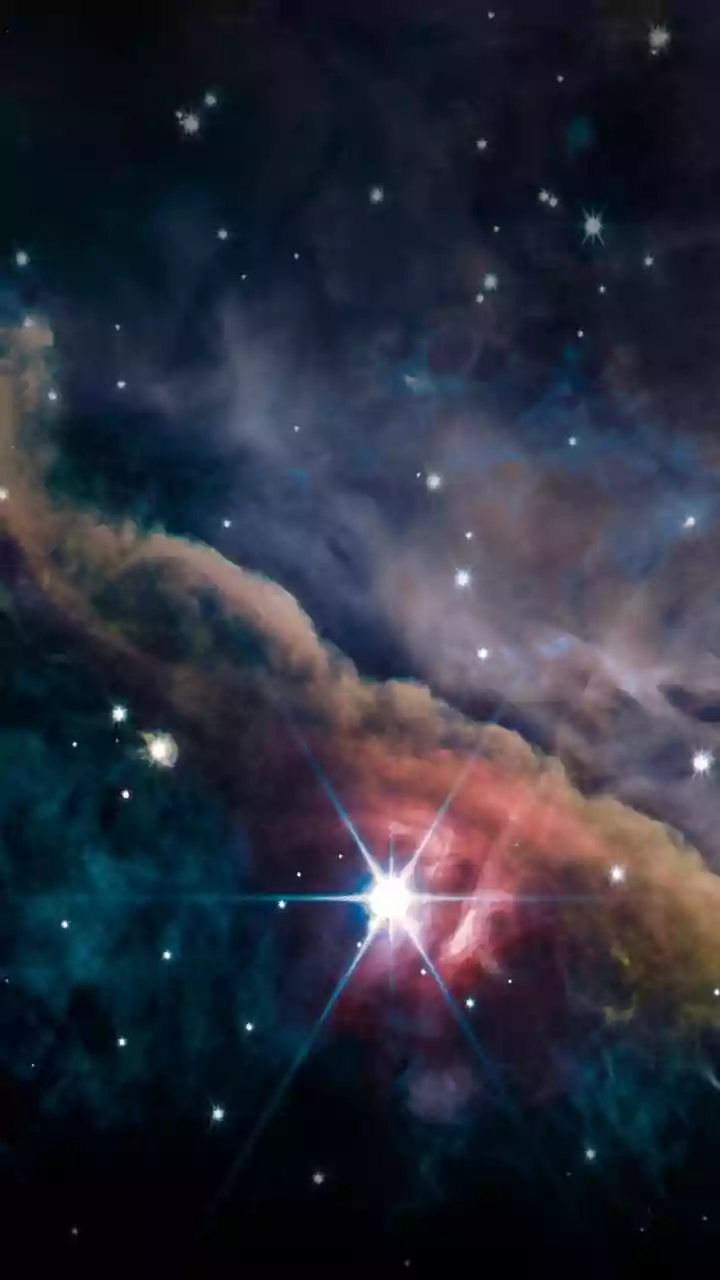



So, What Are These 'Building Sites'?
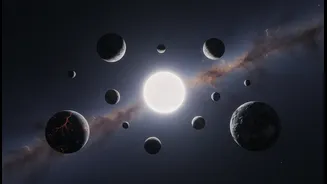
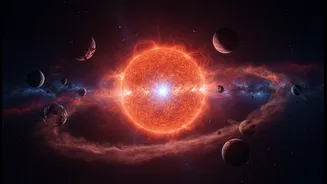
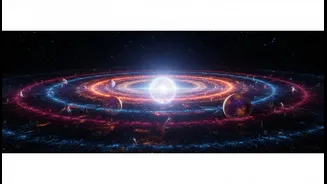
The term 'cosmic building site' isn't an official scientific classification, but it's a wonderfully descriptive way to talk about something astronomers are incredibly excited about: protoplanetary disks. These are vast, rotating disks of gas and dust
that surround very young stars. For millions of years after a star ignites, this leftover material swirls around it like water circling a drain. It’s within these massive, dusty rings that planets, moons, asteroids, and comets are born. Essentially, they are stellar nurseries where new worlds are under construction, and for the first time, we have the technology to get a good look at them.
The High-Tech Tools for the Job
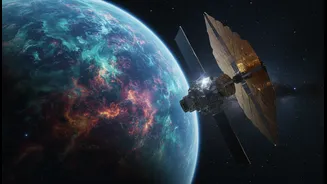
Seeing these distant, dusty construction zones is a monumental technological challenge. The stars they surround are incredibly bright, and the disks themselves are often cool and dark. This is where groundbreaking instruments like the James Webb Space Telescope (JWST) and the Atacama Large Millimeter/submillimeter Array (ALMA) come in. These telescopes are designed to see the universe in infrared and submillimeter light, which allows them to peer through obscuring dust clouds and detect the faint heat signatures of these planet-forming disks. The investment in this technology is paying off, providing images and data so detailed that scientists are getting an unprecedented look at how planets begin to form, sometimes spotting gaps and spirals in the disks that hint at a new planet carving out its orbit.
The Raw Materials of a Planet
Every construction project needs raw materials, and on a cosmic scale, those materials are surprisingly simple: gas and dust. These disks are composed mainly of hydrogen and helium gas, but they're also seeded with heavier elements and compounds created by earlier generations of stars. This includes tiny grains of silicates (rock), soot-like carbon compounds, and ices made of water, methane, and ammonia. Over millions of years, gravity causes these tiny dust grains to stick together, forming larger and larger clumps. This process, called accretion, is like a cosmic snowball effect, building pebbles, then rocks, then planetesimals—the mountain-sized building blocks of planets. Recent JWST observations have even confirmed that icy pebbles can drift from the outer parts of the disk inward, delivering water to the regions where rocky, Earth-like planets might be forming.
Watching Worlds Take Shape
The most exciting part of this research is that we're no longer just theorizing. Scientists are now observing planets in the very act of forming. Data from JWST and ALMA have revealed protoplanetary disks with clear signs of ongoing construction. In some, they see vast, empty lanes, likely swept clear by a giant, newly formed planet. In others, they can detect the chemical signatures of complex organic molecules—the very same molecules that are foundational to life as we know it. Some discoveries are even challenging old assumptions. For instance, astronomers used to think these disks dissipated within about 10 million years, but recent discoveries have found disks that are 20 or 30 million years old, suggesting planets may have much more time to form than previously believed.
Why It Matters Here on Earth
Observing a planet being built around a distant star is more than just a cool astronomical feat; it’s like finding a recording of our own solar system's birth. By studying these cosmic building sites, we can piece together the story of our own origins. We can test theories about how Earth got its water, why the planets are arranged the way they are, and how common planetary systems like ours might be throughout the galaxy. Furthermore, recent studies show that planets can form in even the harshest environments, bathed in intense radiation from nearby massive stars, which expands the potential places to look for life. Each discovery brings us closer to answering one of humanity’s oldest questions: Are we alone in the universe?