







A Lonely Voyager's Lifeline
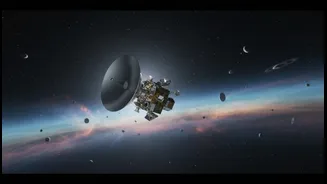
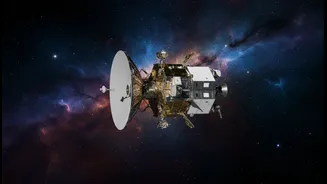
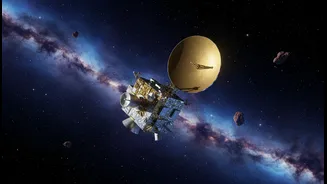
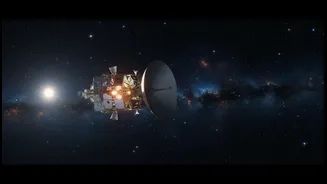
The New Horizons spacecraft is one of humanity's most ambitious explorers. Launched in 2006, its primary mission was the first-ever flyby of Pluto. After a journey of more than nine years and nearly 5 billion kilometres, it was on the final approach in July
2015. But this is no ordinary road trip. At that distance, a radio signal traveling at the speed of light takes 4.5 hours to get from Earth to the spacecraft. A simple command-and-response takes nine hours. This immense communication delay means the spacecraft must be highly autonomous, able to make decisions and keep itself safe while mission controllers on Earth wait, powerless to intervene in real-time.
Crisis Ten Days from Pluto
On July 4, 2015, just ten days before its closest approach to the dwarf planet, the unthinkable happened. The mission operations team at Johns Hopkins University's Applied Physics Laboratory lost contact with New Horizons. For 81 tense minutes, there was only silence. The spacecraft's autonomous systems, detecting a problem, had done exactly what they were designed to do: it entered a protective 'safe mode', switched from its main computer to its backup, and pointed its antenna back toward Earth to await instructions. The cause was later identified as a subtle timing flaw in the command sequence for the flyby; the craft's processor was overwhelmed while trying to compress existing science data and prepare for the intense data collection of the main event simultaneously.
The Nine-Hour Handshake
The term 'instantly' in the headline is a testament to the speed of the software's execution, not the time it took to communicate. With a nine-hour round-trip light delay, the recovery was a slow, methodical dance. Engineers first had to wait for the telemetry from the backup computer to arrive to diagnose the problem. Then, they painstakingly developed a recovery plan, tested it on simulators, and finally began uplinking commands. Each step required a 4.5-hour wait to see if the command was received and executed correctly. The team had to command the spacecraft to switch back to its primary computer—a procedure never before attempted in flight—and then meticulously re-upload the entire flyby command sequence that had been lost during the reboot.
Engineered for Resilience
The successful recovery was no accident; it was the result of deliberate and robust engineering. The New Horizons spacecraft was built with redundant systems for this very reason. It carries two main computers (Command and Data Handling systems), two solid-state data recorders, and backup systems for most major electronics. The processor itself, a radiation-hardened chip called the Mongoose-V, is based on technology from the 1980s. For deep space missions, reliability and a long track record trump raw processing speed. This design philosophy, focusing on resilience and pre-programmed autonomy, allowed the spacecraft to save itself first, giving the human team on the ground the time they needed to solve the problem from across the solar system.
Science Back on Track
The anomaly caused a loss of a few days of observation on the approach to Pluto, but the core mission was preserved. The Anomaly Review Board concluded that no hardware or software was damaged. By July 7, New Horizons exited safe mode and resumed its full science operations, perfectly on track for the historic July 14 flyby. Alan Stern, the mission's Principal Investigator, famously stated that in terms of science, the glitch wouldn't turn an 'A-plus' mission 'even into an A'. The spacecraft went on to perform flawlessly, capturing the iconic, high-resolution images of Pluto's heart-shaped glacier and its moons that redefined our understanding of the outer solar system.