



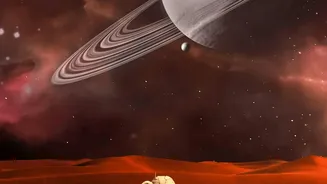
The Curtain Rises on Saturn Season
While Saturn’s absolute peak performance for 2026 will be in early October, August marks the official start of prime viewing season. This is the month when the ringed planet transitions from a late-night object to a convenient evening spectacle. Throughout
August, Saturn will rise progressively earlier in the east, growing brighter and appearing slightly larger in the sky each week. This build-up is part of its journey towards “opposition” on October 4, the point when Earth is directly between Saturn and the Sun. This alignment makes the planet appear at its biggest and brightest for the year from our perspective. August, therefore, is your front-row ticket to the beginning of this magnificent celestial show.
When and Where to Look From India
Finding Saturn is easier than you might think, especially this month. Look towards the eastern horizon in the late evening. At the beginning of August, the planet will appear around 11 p.m. local time, but by the end of the month, you can spot it rising as early as 9 p.m. It will be located in a relatively sparse region of the sky, in the constellation Pisces, which makes the bright planet stand out even more. As the night progresses, it will climb higher, reaching its highest point in the sky after midnight. Its steady, yellowish-white light is a calm beacon in the night sky, a perfect target for anyone with even a casual interest in the cosmos.
What to Expect: Naked Eye and Binoculars
You don't need any special equipment to enjoy Saturn's presence. To the naked eye, it will appear as a bright, star-like point of light. One way to distinguish it from a star is its steady glow; planets tend to twinkle far less than distant stars. If you have a pair of binoculars, you might just be able to notice that Saturn is not a perfect point. With a steady hand, you may perceive a slightly oval or elongated shape, the first hint of its magnificent rings. This simple observation alone can be a thrilling experience, connecting you to a world over 1.3 billion kilometres away.
Unveiling the Rings With a Telescope
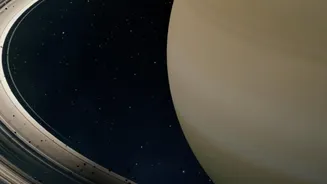
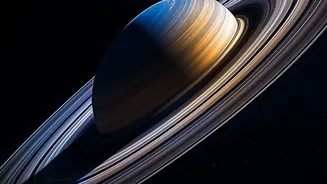
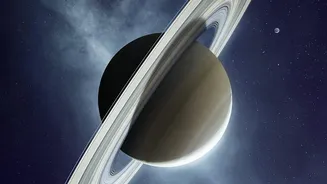
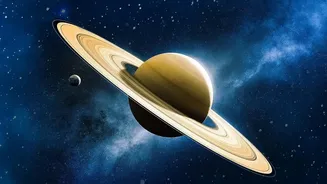
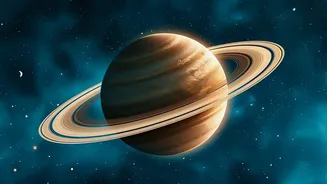
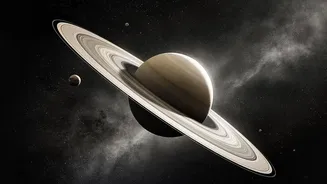
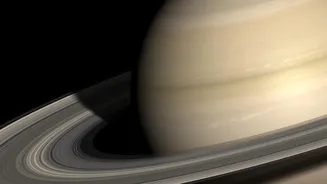
This is where the real magic happens. Even a small, modest telescope is capable of revealing Saturn's most famous feature: its rings. A magnification of just 25x to 50x is enough to show the rings as a distinct structure separate from the planet’s globe, an unforgettable sight for first-time viewers. With a slightly larger telescope and on a night with clear, steady air, you might be able to spot more detail. This could include the Cassini Division, a prominent dark gap in the rings. You may also spot Saturn's largest moon, Titan, appearing as a tiny star-like point of light very close to the planet.
A Celestial Dance in Motion
The reason Saturn puts on such a great show in the coming months is due to the orbital dance between our planet and it. Earth orbits the Sun much faster than Saturn, taking one year compared to Saturn's nearly 30 years. Once a year, Earth 'laps' Saturn, passing between it and the Sun. This event is called opposition. Around this time, Saturn is at its closest point to Earth for the year, making it appear larger and brighter. In August, we are approaching that closest point, and the view will only improve as we head into September and the October 4 opposition. So when you look at Saturn this month, you are witnessing a planetary alignment in the making.