



Why Bodyweight Exercises Work
Before jumping into the exercises, it’s worth understanding why using just your body weight is so effective. Bodyweight training, or calisthenics, builds foundational strength, improves balance, and enhances your body's functional movement patterns. These
exercises often work multiple muscle groups at once — a concept known as compound exercise — which is great for overall fitness and stability. Research has shown that bodyweight resistance training helps build muscle completely independent of external weights. So, you can be confident that you’re not missing out by skipping the heavy dumbbells; you’re building a strong, capable body from the ground up.
1. The Foundational Bodyweight Squat
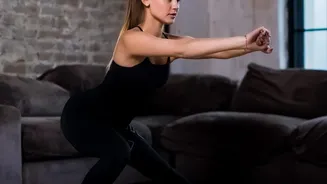
The squat is the undisputed king of leg exercises for a reason. It targets your quadriceps (the front of your thighs), hamstrings (the back), and glutes all in one go. To perform a squat correctly, stand with your feet shoulder-width apart, with your chest up and your core engaged. Begin by pushing your hips back as if you’re about to sit in a chair, then bend your knees to lower your body. Aim to get your thighs parallel to the floor, ensuring your knees track in line with your toes and don't go past them. Keep your weight in your heels as you push back up to the starting position. For beginners, practising with a chair behind you can help perfect the form.
2. The Essential Lunge
Lunges are excellent for challenging each leg individually, which helps identify and correct muscle imbalances while improving your balance and coordination. To start, stand tall and take a big step forward with one leg. Lower your hips until both knees are bent at approximately a 90-degree angle. Your front knee should be directly above your ankle, and your back knee should hover just off the floor. Keep your torso upright. Push off your front foot to return to the starting position, then repeat on the other side.
3. The Side Lunge for Inner and Outer Thighs
While standard squats and lunges are fantastic, they primarily work in a forward-and-back motion. The side lunge, or lateral lunge, targets your inner thighs (adductors) and outer thighs (abductors), muscles that are often neglected. Start with your feet together. Take a wide step to one side, keeping your other leg straight. Bend the knee of your stepping leg and push your hips back, feeling a stretch in your straight leg. Keep your chest up and both feet pointing forward. Push back to the start and repeat on the other side.
4. The Glute Bridge
While it has 'glute' in the name, the glute bridge is a powerhouse for your hamstrings and lower back, crucial components for overall thigh strength and stability. Lie on your back with your knees bent, feet flat on the floor about hip-width apart, and your arms by your sides. Squeeze your glutes and lift your hips off the floor until your body forms a straight line from your shoulders to your knees. Hold for a moment at the top, focusing on the contraction in your hamstrings and glutes, before slowly lowering back down.
Making Progress and Staying Consistent
The key to building strength without adding weights is to progressively challenge your muscles in other ways. You can do this by increasing your repetitions, performing more sets, or slowing down the movement—especially the lowering phase—to increase time under tension. Another great technique is to reduce rest time between sets to improve muscular endurance. You can also progress to more challenging variations, like jump squats for explosiveness or single-leg squats (pistol squats) for a serious test of strength and balance. Remember that consistency is more important than intensity. A few well-executed sessions per week will yield far better results than one exhausting workout every few weeks.