




Cosmic Cities: What Are Galaxy Clusters?
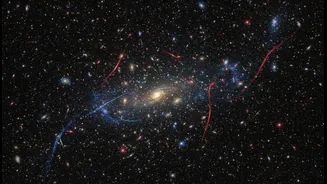
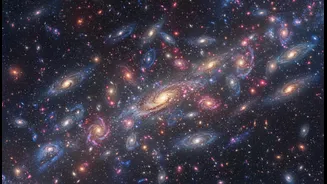
Imagine a metropolis, not of people and buildings, but of entire galaxies. That's a galaxy cluster. These are the largest gravitationally bound structures in the universe, containing anywhere from hundreds to thousands of individual galaxies. These colossal
assemblages can span millions of light-years and have masses up to a thousand trillion times that of our sun. Our own Milky Way galaxy resides on the outskirts of one such structure, the Virgo Cluster. These clusters aren't just random collections; they are the dense, vibrant hubs that define the large-scale structure of the cosmos.
More Than Just Stars
While the galaxies themselves are the most visible component, they make up only a tiny fraction of a cluster's total mass—about two percent. The vast majority of a cluster is composed of two invisible ingredients. First is the intracluster medium (ICM), a superheated plasma of gas between the galaxies that reaches temperatures of tens of millions of degrees. This gas is so hot that it glows brightly in X-ray light, which is how astronomers can study it. The second, and most dominant, component is dark matter. This mysterious substance, which accounts for about 80-85% of the cluster's mass, cannot be seen directly but its immense gravitational pull is what holds the entire structure together. It was the incredible speed of galaxies within clusters that first led astronomers like Fritz Zwicky in the 1930s to infer the existence of this 'missing mass'.
A Hub of Constant Action
The “busy” feeling of a galaxy cluster comes from the intense activity within it. With so many galaxies packed together, collisions and mergers are common events. As galaxies are pulled into the cluster by gravity, they interact, triggering bursts of star formation. The immense gravitational pull of the cluster can also strip gas from smaller galaxies as they move through the hot intracluster medium, a process known as ram pressure stripping. The collision of clusters themselves can create colossal shock waves, heating gas and triggering even more widespread star formation, though this effect can be brief. Over time, however, these interactions tend to use up a galaxy's star-forming fuel, leading many cluster galaxies to become 'red and dead'—filled with old stars but lacking new ones.
Nodes in the Cosmic Web
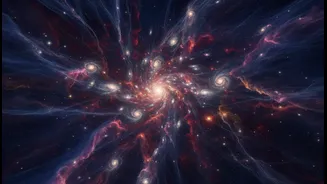
Zooming out, galaxy clusters are not isolated islands. They are the key intersections in an even larger structure known as the cosmic web. The universe's matter is not distributed evenly, but is arranged in a honeycomb-like pattern of massive filaments and vast, empty voids. The filaments, made of gas and dark matter, act like cosmic highways, funnelling material—and entire galaxies—towards the clusters. The galaxy clusters are the dense, massive nodes where these filaments meet, making them the most active and dynamic places in the universe. Recent surveys, including those by the James Webb Space Telescope, are mapping this web in unprecedented detail, showing how this structure has guided galaxy evolution since the early universe.
Tools for Understanding the Universe
Beyond being fascinating objects in their own right, galaxy clusters are powerful tools for cosmologists. Because their immense mass warps spacetime, they act as natural cosmic magnifying glasses. This phenomenon, called gravitational lensing, allows astronomers to see much more distant galaxies that would otherwise be too faint to observe. By studying how the light from background objects is bent, scientists can map the distribution of the invisible dark matter within the cluster. Furthermore, because clusters are a representative sample of the matter in the universe, studying their composition and evolution helps us understand the properties of the cosmos as a whole.