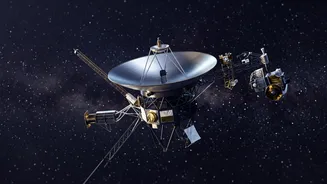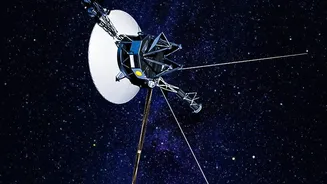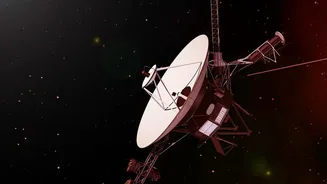

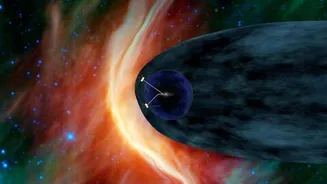
Sometime on November 18, a faint signal from the edge of our solar system will take a full 24 hours to reach us. At that moment, the Voyager 1 probe will be one light-day from Earth, a distance no human object has ever reached.
What is a Light-Day?
It sounds like a unit of
time, but a light-day is a measure of immense distance. It is how far a particle of light travels in a vacuum in 24 hours. Since light moves at nearly 300,000 kilometres per second, a light-day equates to roughly 25.9 billion kilometres. To put that into perspective, light from the Moon reaches us in 1.3 seconds. Sunlight takes about eight minutes to travel to Earth. It has taken Voyager 1, travelling at over 60,000 kilometres per hour, more than 49 years to cover a distance that light crosses in a single day. This milestone isn't just a number; it is a profound illustration of the scale of the cosmos and the incredible challenge of communicating across it. From this point forward, a simple round-trip message between Earth and Voyager 1 will take two full days.
A Journey of Nearly 50 Years
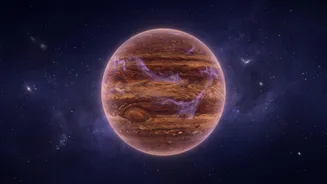
Launched on September 5, 1977, Voyager 1 was part of a historic 'Grand Tour' of the outer planets, taking advantage of a rare planetary alignment. Its primary mission was to study Jupiter and Saturn. It flew past Jupiter in 1979, discovering the planet's faint ring system and the first active volcanoes beyond Earth on the moon Io. In 1980, it reached Saturn, providing stunning, detailed images of its complex rings and making a close flyby of the hazy moon Titan. That flyby, which confirmed Titan's thick nitrogen atmosphere, altered the probe's trajectory, sending it hurtling out of the plane of the solar system and toward the stars. In February 1998, it surpassed the Pioneer 10 probe to become the most distant human-made object in existence, a title it has held ever since.
Humanity's Farthest Messenger
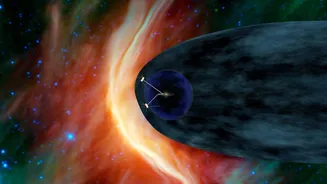
After its planetary encounters, Voyager 1 began its interstellar mission. In August 2012, it crossed the heliopause, the boundary where the Sun's stream of particles gives way to the interstellar medium. It officially entered the space between the stars, the first object made by humanity to do so. Today, it continues its lonely voyage, operating on a dwindling power supply from its plutonium-based generators, which lose about four watts of power each year. NASA engineers have become experts in energy conservation, recently performing complex manoeuvres to shut down non-essential systems to extend the life of its remaining scientific instruments. Despite its age and recent communication glitches, the probe still sends back valuable data about interstellar space at a rate of about 160 bits per second.
The Golden Record's Lonely Voyage
Attached to Voyager 1 is a message in a bottle: the Golden Record. This 12-inch, gold-plated copper phonograph record contains a snapshot of Earth, intended for any intelligent extraterrestrial life that might one day find it. Assembled by a committee led by famed astronomer Carl Sagan, the record includes 116 images, a variety of natural sounds from wind and whalesong to laughter, spoken greetings in 55 languages, and 90 minutes of music from across global cultures. The contents range from Bach and Beethoven to Chuck Berry's 'Johnny B. Goode'. It even includes the brainwaves of writer Ann Druyan, recorded as she thought about Earth's history and the feeling of falling in love. While the chances of it being found are minuscule, the record stands as a time capsule of human hope and curiosity.