


A New 10-Sided Mystery Has Appeared
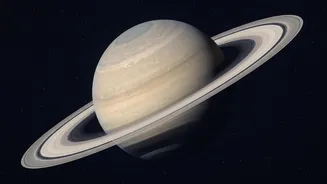
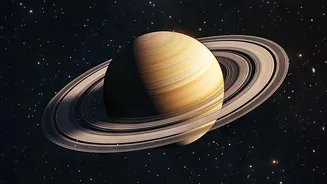
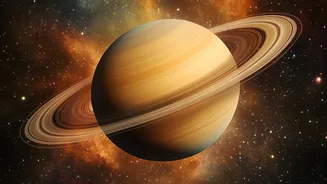
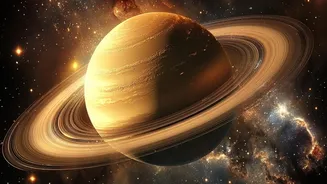
For decades, all eyes were on the north pole's bizarre, six-sided jet stream, known as the hexagon. But recent observations from the Hubble Space Telescope have revealed a surprise counterpart in the south: a massive, 10-sided atmospheric wave, or decagon.
This is the first time such a large, regular-sided pattern has been seen in Saturn's southern hemisphere. Scientists using Hubble's Outer Planet Atmospheres Legacy (OPAL) program were able to trace the feature's development, finding faint hints of it in images from 2023 before it became more clearly defined in subsequent years. Unlike the long-stable hexagon, this southern decagon appears to be a new and evolving phenomenon, giving researchers a rare chance to watch a giant atmospheric structure form in real-time.
The Poles Have Wildly Different Shapes
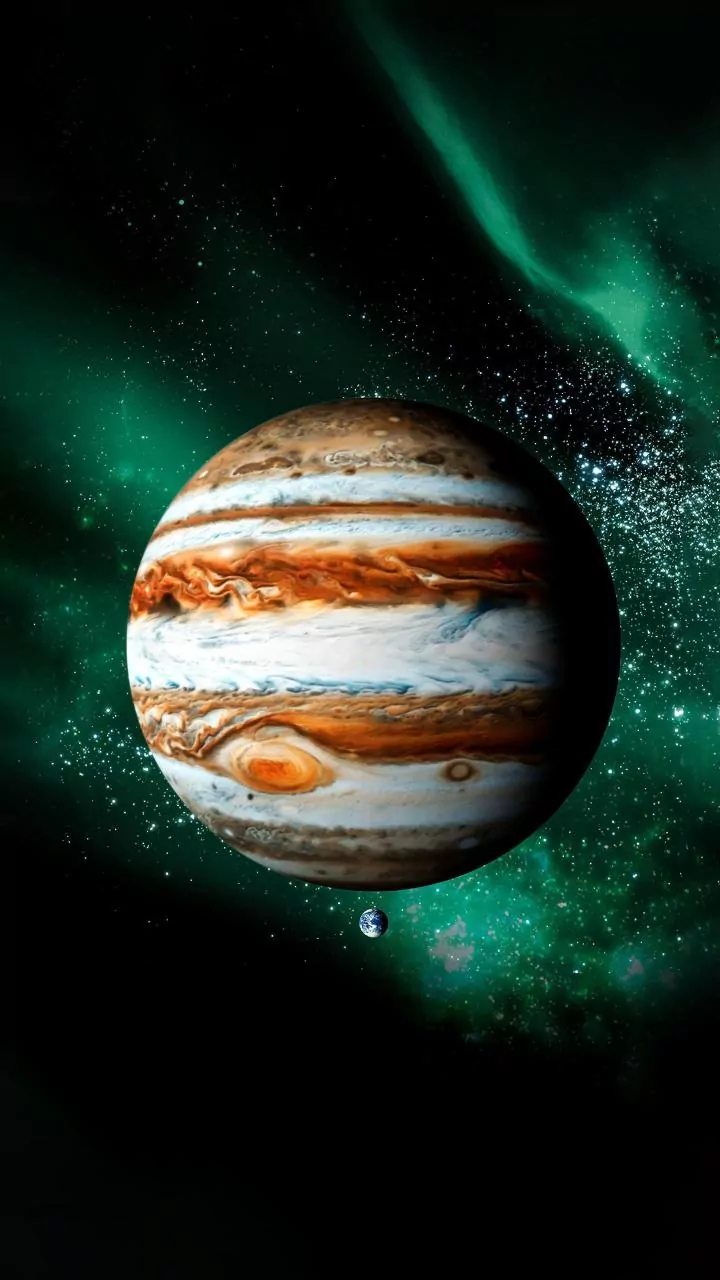
While Jupiter's poles feature a central cyclone surrounded by smaller vortices, Saturn's northern pole is dominated by a single, massive hexagon. This jet stream is about 18,000 miles (nearly 30,000 km) wide, large enough to fit two Earths inside it, and has been raging since it was first spotted in the 1980s. The discovery of the southern decagon adds another layer of complexity. Though similar in that it is a geometric wave in a jet stream, the decagon is distinctly different from the hexagon, not just in its number of sides but also in its behavior. While the hexagon is largely stationary, rotating at nearly the same rate as the planet itself, the new decagon appears to be less stable and is drifting eastward.
These Patterns Are Deep, Multi-Layered Structures
These geometric shapes aren't just superficial patterns on the cloud tops. Observations show that both the northern hexagon and the new southern decagon are vertically extended structures that penetrate deep into Saturn's atmosphere. Saturn's atmosphere is made of several cloud layers. The highest, visible clouds are composed of ammonia ice crystals. Below them are layers thought to be made of ammonium hydrosulfide and, deeper still, water ice clouds. By observing the planet at different wavelengths, which allows them to see different altitudes, astronomers can tell that these polar waves extend through multiple layers. This indicates they are powerful, deeply-rooted phenomena shaped by forces far below the visible surface of the gas giant.
The Jet Streams Are Unimaginably Fast
The geometric patterns at Saturn's poles are defined by jet streams—fast-flowing currents of air. And on Saturn, "fast" is an understatement. The jet stream associated with the northern hexagon whips around the planet at more than 200 mph (about 320 km/h). Elsewhere on the planet, the winds are even more extreme. Near the equator, wind speeds have been measured at a staggering 1,100 mph (about 1,800 kph), making them some of the fastest in the solar system. These powerful winds are what confine the polar vortices and give them their distinct, geometric shapes. In lab experiments, scientists have been able to replicate hexagonal shapes by rotating a circular tank of liquid at different speeds, mimicking the shearing forces between different wind speeds in Saturn's atmosphere.
It’s All Powered From Within
While weather on Earth is driven largely by solar energy, Saturn's bizarre atmosphere is a different beast. The planet radiates more heat than it receives from the sun, meaning its weather is powered by an internal engine. Heat rising from the planet's deep interior drives the complex atmospheric dynamics, fueling the massive storms and ultra-fast jet streams. This internal heat helps explain how a feature like the hexagon can persist for decades—and perhaps centuries—unlike a hurricane on Earth, which typically lasts only a week. The discovery of the new southern decagon raises questions about why it formed now, with some scientists speculating that seasonal changes and increasing sunlight on the south pole may be playing a role in its recent emergence.