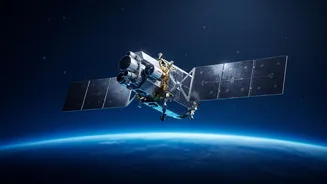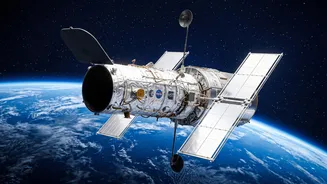




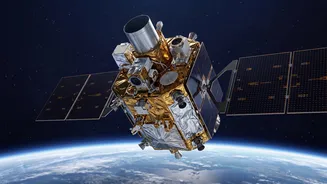
For over 35 years, the Hubble Space Telescope has been humanity's eye on the cosmos. But its legendary mission is at risk as its orbit slowly decays. A groundbreaking commercial rescue mission could add decades to its life, but it remains just an idea.
A Fading Orbit
The Hubble Space Telescope is one of the most productive scientific instruments ever built, fundamentally changing our understanding of the universe. Despite its age, it continues to deliver groundbreaking science and iconic images. But Hubble has a problem it cannot fix on its own: it is slowly falling. Like all objects in low-Earth orbit, it experiences faint atmospheric drag that causes its altitude to drop over time. Since the last space shuttle servicing mission in 2009, its orbit has steadily decayed. Without an engine to correct its path, Hubble is projected to make an uncontrolled reentry into Earth's atmosphere sometime in the mid-2030s. While much of it would burn up, some components could potentially survive and pose a risk on the ground.
A Commercial Lifeline Emerges
The idea of a commercial rescue mission gained significant traction in 2022. NASA and SpaceX signed a Space Act Agreement to study the feasibility of using a SpaceX Dragon spacecraft to rendezvous with Hubble. The study, proposed in partnership with the Polaris Program led by billionaire Jared Isaacman, was designed to explore the technical challenges of boosting the telescope to a higher, more stable orbit. Such a 'reboost' could add 15 to 20 years to Hubble's operational life, allowing its unique observational capabilities in visible and ultraviolet light to continue alongside the infrared-focused James Webb Space Telescope. The initial study was conducted at no cost to the US government, highlighting a new model for public-private partnerships in space.
Study, Not a Contract
Despite initial enthusiasm, the 2022 feasibility study did not lead to a mission. In June 2024, NASA announced it would not pursue a reboost at that time, citing risks to the still-healthy observatory and technical challenges. However, the conversation is far from over. In a significant recent development, NASA issued a new Request for Information (RFI) on October 29, 2026, once again asking the commercial space industry for ideas. This RFI explicitly clarifies that it is a market research tool, not a formal request for proposals or a contract award. NASA has not allocated any funding for a mission. The agency is asking companies to submit concepts by November 30, 2026, for one of three options: reboosting Hubble to a higher orbit, servicing it with new technology, or performing a safe, controlled de-orbit.
The Hurdles to a Handshake
The path from an RFI to an approved flight is complex. Any company that responds must provide its own launch vehicle, spacecraft, and mission operations. The mission itself is high_risk. Rendezvousing with and capturing a legacy satellite not designed for modern servicing is a major technical challenge. A previous attempt to rescue a different NASA observatory, the Neil Gehrels Swift Observatory, failed in 2026 after the robotic servicing spacecraft experienced technical problems, providing a sobering reminder of the difficulties involved. For Hubble, NASA officials have previously expressed concern about the risks of a private mission, including potential contamination of the telescope's optics. Now, the agency is re_evaluating those risks against the potential reward of extending the life of a valuable scientific asset, spurred on by an evolving commercial industry.
The Clock Keeps Ticking
With a potential reentry in the mid–2030s, NASA has stated that any rescue or reboost mission would need to be carried out by 2032. The recent RFI is a crucial step in determining if the commercial market has matured enough to offer a viable, cost–effective, and safe solution. The responses due at the end of November will give NASA a clearer picture of what is possible. Options could range from a robotic tug, like those proposed by companies such as Astroscale and Momentus, to a crewed mission. Interestingly, the man who first championed the private Hubble rescue, Jared Isaacman, is now in the position of NASA Administrator, adding a new dimension to the agency's decision–making process. His support for exploring commercial options is clear, but the final decision will rest on the technical feasibility and risk assessments of the proposals received.