



A Frozen Frontier
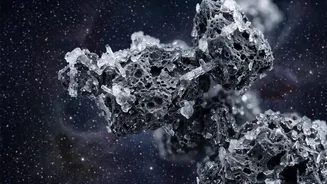
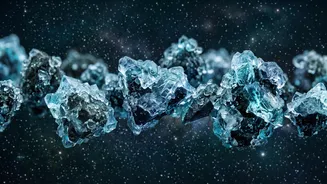
Beyond the orbit of Neptune lies the Kuiper Belt, a vast, donut-shaped region of icy bodies left over from the formation of the solar system about 4.6 billion years ago. This cosmic deep-freeze is home to dwarf planets like Pluto, as well as millions
of smaller, frozen objects. Because they are so far from the Sun, these Kuiper Belt Objects (KBOs) are considered some of the most pristine and least-altered materials available, offering a direct window into the early chemistry of our cosmic neighbourhood. They are primarily composed of a mix of rock and frozen 'ices' like water, methane, and ammonia.
Cosmic Dust Tells a Story
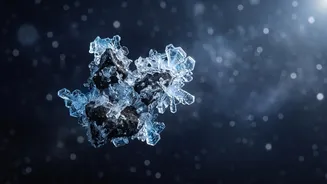
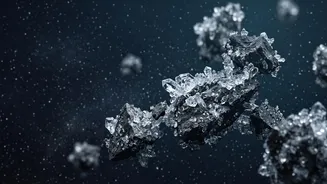
While we can't easily visit most KBOs, they send messengers to us. Collisions between these icy bodies, as well as their slow erosion, release a steady stream of tiny interplanetary dust particles (IDPs). Some of this dust spirals inward toward the Sun, eventually entering Earth's upper atmosphere. For decades, NASA has collected these microscopic grains from the stratosphere for laboratory analysis. A recent study, led by planetary scientist Lindsay Keller, focused on identifying dust that originated specifically in the Kuiper Belt. They did this by looking for particles with a high density of scars from solar energetic particles, which indicates a very long journey from the outer solar system.
The Signature of Liquid Water
Analysis of twelve of these dust grains revealed something remarkable. They contained hydrated minerals, specifically types of clays like saponite and serpentine, as well as carbonates. These minerals can only form when rock comes into contact with liquid water. This finding suggests that the parent bodies of these dust grains—ancient objects in the Kuiper Belt—once had liquid water in their interiors, likely melted by heat from radioactive decay or impacts early in their history. Though the Kuiper Belt is now frozen solid, these tiny mineral grains act as time capsules, preserving the chemical evidence of this long-lost water.
A Different Kind of Water
The most significant part of the discovery lies in the water's specific chemical makeup. The minerals contained oxygen isotopes—heavier versions of the oxygen atom—that are distinct from the water found in the inner solar system, including Earth's oceans. This 'heavy' oxygen signature provides compelling evidence that the outer solar system hosted a major water reservoir that remained largely isolated and did not mix extensively with materials closer to the Sun. This confirms a long-held scientific prediction and shows that the primordial cloud of gas and dust that formed our solar system was not uniform.
Implications for Our Origins
This discovery has profound implications for understanding where Earth's water came from. For a long time, scientists have debated whether our planet's oceans were delivered by comets or asteroids. While many comets originate in the Kuiper Belt, their water composition has often been a poor match for Earth's. These new findings don't solve the debate, but they add a crucial piece to the puzzle. They confirm that vast amounts of water existed in the outer solar system, but with a different isotopic fingerprint. By studying these pristine samples, scientists can better reconstruct the chemical geography of the early solar system and trace the journey of water and other life-enabling ingredients from the outer reaches to planets like our own.