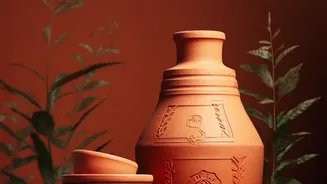









The Earth's Canvas
The journey of any clay decoration begins with the soil itself. The specific type of clay gives each regional craft its unique character. In Gorakhpur, Uttar Pradesh, artisans rely on the special 'Kabis' clay found in local ponds, which is only accessible
during the dry months of May and June. Similarly, the renowned Molela terracotta artists of Rajasthan source their supple, sticky clay from the banks of the Banas river. This raw material isn't used as is; it undergoes a meticulous process of cleaning to remove impurities, followed by soaking and kneading. Often, other local materials are mixed in to improve its workability and strength. Artisans in Molela, for instance, mix two types of clay with sifted cow dung. This preparation, passed down through generations, ensures the clay has the perfect consistency for shaping and can withstand the intense heat of firing without cracking.
Shaping by Hand and Heart
Once the clay is prepared, the artisan's skill truly comes to the forefront. While the potter's wheel is a common tool for creating vessels and symmetrical items, many decorative pieces are shaped entirely by hand. This is especially true for the relief plaques of Molela, where figures from mythology and daily life are built up layer by layer on a flat clay base. Artisans use simple tools—bamboo slivers, wooden spatulas, and sometimes just their fingers—to sculpt intricate details, from the folds of a garment to the expression on a deity's face. This hands-on method allows for immense creativity and ensures that no two pieces are exactly alike. The shaped items are then left to dry slowly in the sun, a crucial step that strengthens the clay before it faces the trial by fire.
A Palette Sourced from Nature
The vibrant colours that adorn many clay decorations are often derived directly from the local environment. Rather than synthetic paints, traditional artisans create their own pigments. The iconic red-brown hue of terracotta comes from the iron-rich clay itself, enhanced by the firing process. For other colours, artisans turn to the botanical world. Turmeric provides a brilliant yellow, pomegranate rinds yield shades of yellow and earthy brown, and madder root creates deep reds. In some traditions, minerals are key. The famous red 'geru', an ochre soil, is a common surface coating. For black, artisans might use a mixture of rusted iron and jaggery, or create a black slip through a special smoke-firing technique where kiln vents are sealed to trap smoke. These natural dyes are not just colouring agents; they are an integral part of the craft's sustainable and eco-friendly identity.
The Trial by Fire
Firing is the transformative final step where raw, sun-dried clay becomes durable, lasting terracotta. The methods vary greatly, from open-air pits to more structured traditional kilns. The fuel itself is local, often consisting of firewood, dry leaves, twigs, and cow dung cakes. The temperature and duration of the firing are controlled with an expertise born of experience, not digital gauges. The way the pieces are stacked and how the heat circulates affects the final colour and hardness. Some artisans, particularly those creating the famed black pottery of Azamgarh, use a special 'smoke firing' technique. After the initial baking, the hot items are covered, and the kiln is sealed with rice husks to produce a dense smoke, which gives the pottery its signature glossy black finish. This firing process is both a science and an art, a dramatic conclusion to the clay's journey.
More Than Just Decoration
These locally sourced and crafted decorations are far more than just beautiful objects. They are deeply embedded in the cultural and spiritual life of their communities. The Molela plaques, for example, are traditionally made as votive offerings for local deities, purchased by tribal communities from Rajasthan, Gujarat, and Madhya Pradesh who believe they bring good fortune and can cure illnesses. The craft is often a family affair, with knowledge and skills passed down from one generation to the next. It serves as a vital source of income and identity for artisan villages like Gorakhpur and Molela, whose crafts have earned Geographical Indication (GI) tags, officially recognizing their unique origin and quality. Supporting these artisans means preserving a slice of India's rich, living heritage.