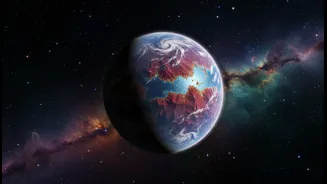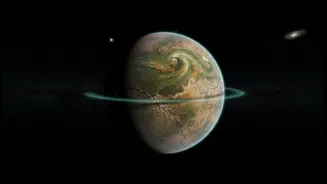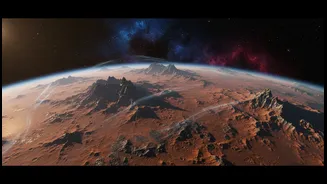




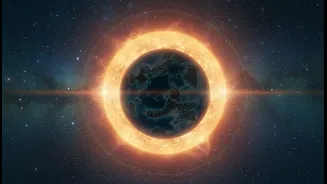


First, What Are Super-Earths?
Before diving into this specific discovery, let's clarify the term 'super-Earth'. It might sound like a planet just like ours, but bigger and better. In reality, it is a simple size classification. Astronomers use the term for planets that are more massive
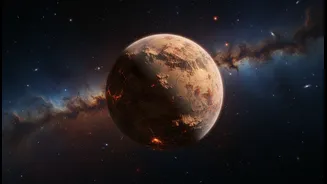
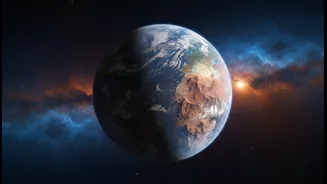
than Earth but lighter than ice giants like Neptune and Uranus. These worlds can be rocky, gaseous, or a combination, and they represent a class of planet that, strangely enough, does not exist in our own solar system. Despite their absence here, they are incredibly common throughout the galaxy, making them a key area of study for understanding how planets form and evolve.
Meet GJ 3378 b: A Close Cosmic Neighbour
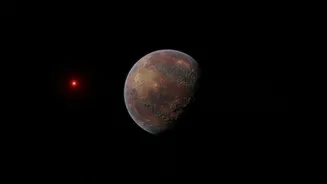
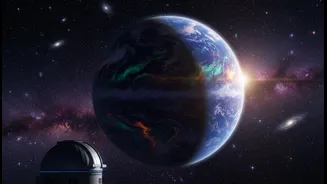
The planet of the hour is called GJ 3378b. It orbits a red dwarf star—a type of star much cooler and dimmer than our Sun—in the constellation Camelopardalis. At just 25 light-years away, it's considered a next-door neighbour in the vastness of the Milky Way galaxy. This proximity is a huge advantage, as it makes the planet a much easier target for our telescopes to study in detail. First identified as a planetary candidate in 2024, GJ 3378b has recently come under renewed scrutiny, leading to some exciting new conclusions about its true nature.
A Second Look Reveals a New Story
The latest buzz comes from a study published in The Astrophysical Journal, where astronomers used new data to refine their understanding of the planet. Initially, they estimated its mass to be about five times that of Earth. However, new observations have revised this figure downwards, to just 2.3 times Earth's mass. This might seem like a small change, but it's hugely significant. Planets above a certain mass tend to accumulate thick, crushing gas atmospheres, becoming more like mini-Neptunes. A lower mass makes it much more likely that GJ 3378b is a rocky, terrestrial world like Earth, Mars, or Venus.
The 'Goldilocks' Zone and a Big Question
Adding to the intrigue, GJ 3378b orbits within its star's 'habitable zone'. This so-called 'Goldilocks' region is where the distance from the star is just right for temperatures that could allow liquid water to exist on a planet's surface. GJ 3378b receives about 90% of the stellar radiation that Earth gets from the Sun, putting it in a temperate sweet spot. However, this doesn't automatically mean it's a water world. The biggest question remains its atmosphere. We don't yet know if it has one, and an atmosphere is crucial for protecting a surface from harsh stellar radiation and maintaining liquid water.
Why This Is Exciting (Without The Aliens)
Discoveries like this are a perfect illustration of how science works. It's not about a single 'Eureka!' moment but a process of gradual refinement, where new data and better tools allow us to sharpen our view of the cosmos. The excitement around GJ 3378b isn't based on finding life, but on finding a nearby, potentially rocky world in a temperate orbit—a prime candidate for future study. It validates the incredible power of the instruments astronomers use, like the Habitable-zone Planet Finder and the NEID Spectrometer, which made these precise measurements possible. The wonder comes from the act of discovery itself and the potential for deeper understanding.
What Comes Next for This Super-Earth?
GJ 3378b is now a top-tier target for the next generation of observatories. While we cannot tell if it has an atmosphere yet, future powerhouses like NASA's planned Habitable Worlds Observatory could be capable of studying the planet directly. Such telescopes might one day be able to parse the light from the planet's atmosphere, searching for chemical clues—or biosignatures—that could hint at the conditions there. For now, GJ 3378b represents a tantalising question mark in our cosmic neighbourhood, a world that promises to teach us more about the variety of planets in our galaxy and our own place within it.