



A Sweet Discovery Near the Galaxy's Heart
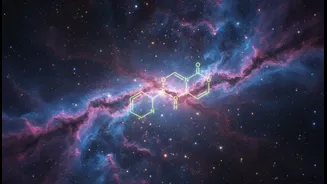
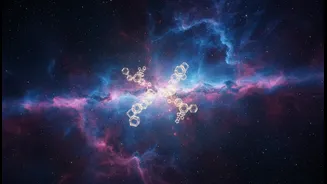
An international team of astronomers has identified a four-carbon sugar called erythrulose floating in a giant molecular cloud known as G+0.693−0.027. This enormous stellar nursery, located about 27,000 light-years away near the centre of our Milky Way,
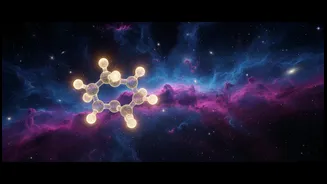
is a cold, dense region where new stars and planets are born. The discovery is significant because while simpler organic molecules have been found in space before, this is the first time a true sugar has been detected directly in the interstellar medium—the gas and dust that exists between star systems. Using powerful radio telescopes in Spain, researchers picked up the faint radio signals emitted by the erythrulose molecules. They confirmed the finding by matching 12 distinct spectral lines from the cloud with the unique chemical fingerprint of erythrulose measured in a laboratory. On Earth, this specific sugar is a natural compound in red raspberries and is also used as an ingredient in sunless tanning lotions.
Challenging How Cosmic Ingredients Are Made
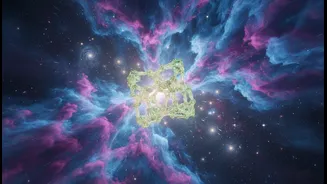
The detection of erythrulose is more than just a sweet surprise; it challenges long-held theories about how complex molecules form in the cosmos. For decades, the prevailing view in astrochemistry was that molecules in space grow sequentially, with smaller molecules gradually adding one carbon atom at a time to become more complex. However, the team found that erythrulose, a four-carbon sugar, was at least eight times more abundant in the cloud than any simpler three-carbon sugars. In fact, no three-carbon sugars were detected at all. This suggests a different chemical recipe is at play. The current hypothesis is that erythrulose isn't built carbon by carbon. Instead, it likely forms on the icy surfaces of cosmic dust grains when two simpler, two-carbon molecules merge. This discovery shows that the universe has efficient pathways to build relatively complex organic compounds even in the harsh, cold environment of a pre-stellar cloud.
A Cosmic Delivery Service for Life
So, why does finding sugar thousands of light-years away matter for us? Sugars are fundamental building blocks for life as we know it. They form the structural backbone of DNA and RNA, the molecules that carry our genetic code. One of the biggest questions in science is how these crucial ingredients first appeared on early Earth to kickstart life. This discovery lends strong support to the theory that Earth may have received a cosmic delivery. Scientists believe that billions of years ago, during a period called the Late Heavy Bombardment, comets and asteroids rained down on our young planet. These celestial visitors could have delivered vast quantities of prebiotic molecules—including sugars like erythrulose—that were pre-made in interstellar clouds. Based on its abundance in this one cloud, the research team estimates that millions of tonnes of erythrulose could have landed on early Earth, providing a ready-made starter kit for biology.
The Search for Life's Missing Pieces
While erythrulose itself is not the sugar found in our DNA (that would be ribose, a five-carbon sugar), its presence is a tantalizing clue. Some astrobiologists theorize that the earliest forms of life may have used simpler genetic systems based on four-carbon sugars before evolving to use the more complex five-carbon structure of RNA and DNA. The detection of erythrulose proves that four-carbon sugars can form abundantly in space. This makes it a crucial stepping stone. It's also only the second chiral molecule—a molecule with a “handedness” like our left and right hands—to be found in interstellar space, another key property of the molecules of life. The next frontier for astronomers is to search for even more complex sugars like ribose in these distant clouds. Finding it would provide even more direct evidence that the fundamental components of life are not unique to Earth but are widespread across the galaxy.