



More Than Just a Wish
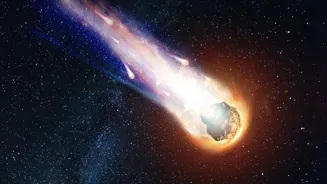
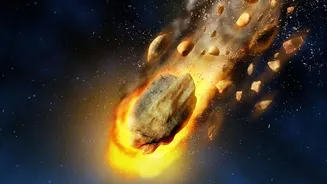
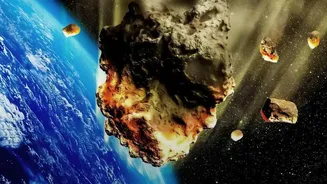
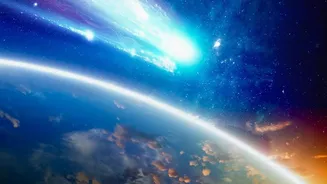
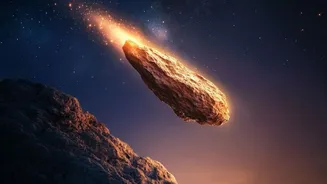
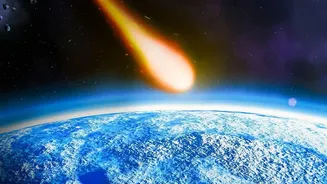
That brilliant flash you call a shooting star is technically a meteor, the visible phenomenon that occurs when a small particle from space, called a meteoroid, enters Earth's atmosphere. These particles, often no bigger than a grain of sand, travel at immense
speeds. When they hit our atmosphere, they compress the air in front of them, generating intense heat that causes them to glow and vaporise. While most burn up completely, they are not just random specks. Most meteoroids are fragments shed by comets or broken off from asteroids, travelling in streams along the orbit of their parent body. By studying the light and trajectory of a meteor, astronomers can perform a kind of celestial detective work, tracing it back to its source.
Clue 1: The Need for Speed
One of the first and most vital clues is the meteor's velocity. A meteoroid's speed upon entering our atmosphere can range from a brisk 11 km/s to a blistering 72 km/s. This incredible range is a direct result of how the meteoroid's own orbit interacts with Earth's. If a meteoroid is travelling in a similar orbit and direction to Earth and essentially catches up from behind, its relative speed will be on the lower end. These 'slower' meteors often originate from the asteroid belt between Mars and Jupiter. On the other hand, a meteoroid on a long, elliptical orbit that collides with Earth head-on will have a much higher combined velocity, putting it at the fast end of the scale. These high-speed meteors are typically debris from comets that swing in from the outer solar system.
Clue 2: A Sense of Direction
When Earth passes through a dense stream of debris left by a comet or asteroid, we experience a meteor shower. During a shower, all the meteors appear to stream from a single point in the sky, known as the radiant. This is a matter of perspective, similar to how parallel railway tracks appear to converge in the distance. The location of this radiant point is another crucial clue. Because the debris stream follows the orbit of its parent body, the radiant's position in the sky helps astronomers associate the shower with a specific path. For example, the famous Perseid meteor shower in August has its radiant in the constellation Perseus, because Earth is intersecting the orbital path of Comet Swift-Tuttle at that time of year. Observing this common point of origin confirms that the individual meteors are part of a related group.
Clue 3: The Orbital Fingerprint
The ultimate goal is to reconstruct the meteoroid's original orbit around the Sun. Using sophisticated camera networks and sometimes radar, scientists precisely measure a meteor's trajectory and speed through the atmosphere. With these data points—its velocity and angle of entry—they can mathematically work backwards. They account for Earth's gravity, which alters the particle's path, to calculate what its heliocentric (Sun-centered) orbit looked like before it ever encountered our planet. This calculated orbit is like a unique fingerprint. Astronomers can then compare this orbital fingerprint to the known orbits of thousands of comets and asteroids. When they find a match, they can confidently identify the meteor's parent body, linking a tiny flash in the sky back to a specific object, like asteroid 3200 Phaethon for the Geminids meteor shower.