






A New Model for Lunar Delivery
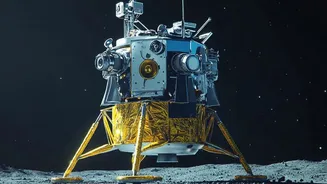
At the heart of this new lunar push is the Commercial Lunar Payload Services (CLPS) initiative. Instead of building and flying all its own landers, NASA is hiring American companies to deliver its scientific and technological payloads to the Moon's surface.
This approach is designed to be faster and foster a commercial space economy. To date, NASA has awarded 17 delivery contracts to companies like Intuitive Machines, Firefly Aerospace, and Astrobotic to transport more than 60 instruments. While there have been mixed results, including some failed and lopsided landings, the program represents a fundamental shift in how NASA gets things to the Moon, allowing the agency to focus on the science while industry handles the ride.
The Ultimate Interplanetary Survival Guide
NASA recently selected three new suites of scientific instruments through its Payloads and Research Investigations on the Surface of the Moon (PRISM) program to fly on upcoming CLPS missions. These aren't random experiments; they're specifically designed to answer the biggest questions about how to live and work safely on the Moon. As Nicky Fox, a leading NASA science administrator, puts it, the agency is building 'the ultimate interplanetary survival guide' to ensure future astronauts have the information they need to thrive. The investigations will focus on three critical areas: understanding environmental hazards, searching for natural shelters, and mapping vital resources like water ice.
Monitoring the Lunar Environment
One of the chosen payloads is the Lunar Environment Monitoring Station – South Pole (LEMS-SP). This autonomous station is a long-term weather and hazard monitor for the Moon. It will use a seismometer to listen for 'moonquakes' and track the impacts of tiny micrometeoroids. It will also measure volatiles—materials that easily turn to gas—drifting in the Moon’s incredibly thin atmosphere. This data is crucial for designing habitats and equipment that can withstand the harsh lunar environment and assessing risks for astronauts working on the surface.
Searching for Subsurface Shelters
Another investigation, with the fitting name GIMLI (Geophysical Investigation for Mapping Lunar Interior), is going cave hunting. Scientists have long theorized that the Moon has underground lava tubes, which are cave-like structures left behind by ancient volcanic flows. GIMLI will be deployed near the Marius Hills Pit, a large hole on the lunar surface, and use ground-penetrating radar and other instruments to search for evidence of these subterranean voids. Finding a lava tube would be a game-changer for a future moon base, as it could provide natural, ready-made protection from extreme temperature swings and dangerous space radiation.
Hunting for Hidden Water Ice
Perhaps most critical for long-term settlement is the search for water. The Depth Imager with Spectral and Color Optics (DISCO) payload is designed to do just that. It will provide the first-ever direct, on-the-ground measurements of ice hidden in the Moon's 'micro-cold traps'—small, permanently shadowed craters that are extremely abundant. Finding and quantifying this ice is a top priority, as it could be processed into drinking water, breathable air, and even rocket fuel. DISCO will also study the soil itself to understand how it behaves when a rocket lands and how stable it is for building structures and driving rovers.