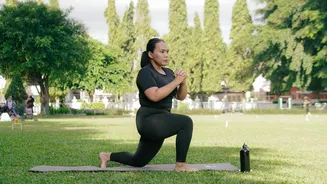







Taking your workout into the fresh air is a great way to break up routine. The walking lunge is a powerhouse exercise perfect for the park or track, but doing it safely and effectively comes down to one thing: mastering proper form.
The All-in-One Leg Builder
So, why choose walking
lunges? This single dynamic movement is a fantastic way to build functional strength. Each step is a compound exercise that targets multiple major muscle groups in your lower body all at once. The primary movers are your quadriceps and your gluteus maximus, which do the heavy lifting to lower you down and push you back up. Your hamstrings, calves, and the adductor muscles of your inner thigh also play crucial supporting roles. Beyond just building muscle, walking lunges are a unilateral exercise, meaning they train one leg at a time. This is incredibly effective for improving your balance and coordination, exposing and helping to correct strength imbalances between your left and right side that can be hidden by exercises like squats. The continuous movement also keeps your heart rate elevated, providing a light cardiovascular challenge.
Your Step-by-Step Guide to Form
To perform a walking lunge correctly and safely, focus on slow, controlled movements. Start by standing tall with your feet hip-width apart and your core engaged to stabilize your spine. Keep your chest up and your shoulders back, looking straight ahead at a spot on the horizon. Take a controlled step forward with one leg. The length of your step should be moderate—not too short and not too long. Lower your hips straight down until both of your knees are bent at approximately a 90-degree angle. Your front shin should be roughly vertical, with your front knee tracking over your ankle, not shooting past your toes. Your back knee should hover just above the ground without touching it. Pause for a moment at the bottom, then drive through your front foot to stand up, bringing your back leg forward to meet your front leg. You can then step forward with the opposite leg to begin the next repetition, continuing this alternating pattern as you move forward.
Common Mistakes and How to Fix Them
Even a great exercise can be ineffective or risky if done incorrectly. The most common error with walking lunges is poor knee alignment, where the front knee either collapses inward or travels too far forward over the toes. This places unnecessary stress on the knee joint. To fix this, consciously push your front knee slightly outward so it aligns with your second or third toe. Another frequent mistake is leaning your torso too far forward or rounding your back. This often happens due to a weak core or trying to move too fast, and it shifts the load to your lower back instead of your legs. The solution is to brace your core and keep your chest lifted throughout the movement. Finally, avoid rushing your reps or using momentum to swing from one lunge to the next. Each step should be deliberate and controlled to maximize muscle engagement and prevent injury.
Tips for Taking Your Lunges Outside
Performing walking lunges outdoors requires a bit more awareness than doing them in a gym. The most important factor is your choice of surface. Look for a flat, even path, like a running track, a paved trail, or a well-maintained grassy field. Be vigilant about your surroundings and watch out for uneven ground, potholes, or loose gravel that could cause you to lose your balance and trip. Wearing supportive shoes with good footing is also essential. Consider mapping out your route beforehand so you can focus on your form rather than on navigation. It's also wise to check the weather forecast and dress in appropriate layers. And while music can be motivating, keep the volume low enough that you remain aware of your surroundings, including other people, cyclists, or pets.