



What is This Planetary Alignment?
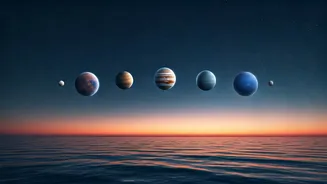
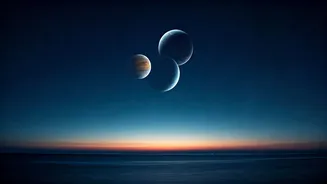
Tonight, sky-gazers are being treated to a planetary conjunction, which is a fancy term for when two or more planets appear very close to each other in our sky. It's important to know they aren't actually close to each other in space—they are still millions
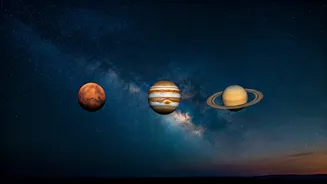
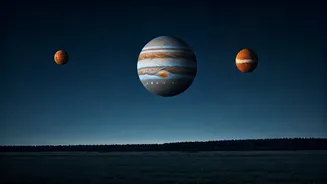
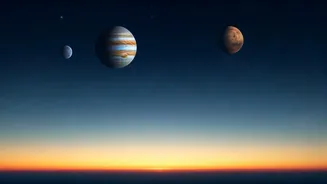
of kilometres apart! This is purely a line-of-sight illusion from our vantage point on Earth. Think of it like seeing two distant streetlights appear right next to each other when you look at them from a specific angle. This particular event involves the speedy planet Mercury, the giant Jupiter, and the red planet Mars, creating a compact and striking triangle of light just after sunset.
Meet the Celestial Trio
Getting to know the stars of the show makes watching them even more rewarding. Jupiter, the largest planet in our solar system, will be the brightest of the three, shining with a steady, brilliant white light. It's often mistaken for a bright star, but planets don't twinkle as much as stars do. Mars will be identifiable by its distinct reddish-orange hue, a colour that comes from the iron oxide (or rust) on its surface. Finally, Mercury is the trickiest to spot. As the closest planet to the Sun, it never strays far from its glare, making it visible only for a short window during twilight. It will appear as a much fainter point of light compared to Jupiter.
When and Where to Look
Timing and direction are everything for an event like this. The best time to look is roughly 30 to 60 minutes after the sun has completely set. You’ll need to face the western horizon—the same direction where the sun went down. The planets will be very low in the sky, so an unobstructed view is crucial. Buildings, trees, or hills can easily block the sight. As the sky darkens, Jupiter will pop into view first, followed by Mars and then the fainter Mercury. The entire trio will sink below the horizon not long after, so the viewing window is quite short. Be ready and be patient.
Naked Eye, Binoculars, or Telescope?
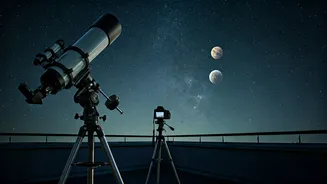
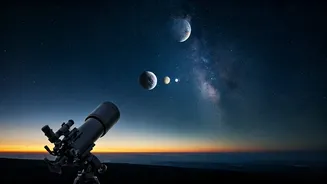
The good news is that you don't need expensive equipment to enjoy this show. Jupiter and Mars are bright enough to be easily seen with the naked eye, even from moderately light-polluted urban areas. Mercury will be more of a challenge but should also be visible without aid if you have a clear sky and know exactly where to look. However, if you have a pair of binoculars, you'll be in for a treat. Binoculars will make all three planets appear sharper and brighter, and they will make spotting faint Mercury significantly easier. If you have a small telescope, you can take it a step further. Point it at Jupiter, and you might even glimpse its four largest moons—Io, Europa, Ganymede, and Callisto—appearing as tiny pinpricks of light flanking the giant planet.
Tips for the Best View
To maximise your chances of a great viewing experience, try to get away from the glare of city lights. Even a local park or a slightly darker neighbourhood can make a huge difference. Give your eyes at least 15 minutes to adapt to the darkness; this will help you see fainter objects like Mercury. You can also use a stargazing app on your phone (like Stellarium, SkyView, or Star Walk) to help you locate the planets. Just point your phone at the sky, and the app will show you exactly where to look. It’s a fantastic tool for beginners and a great way to confirm you’re looking at the right celestial bodies.