




The Sun, our life-giving star, has a volatile side. New research confirms our power grids are more vulnerable than we knew, revealing some solar storm effects can strike not in days or hours, but in mere minutes, rewriting our disaster prep playbook.
What Are Solar Storms?
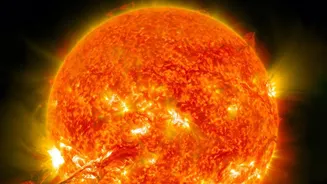
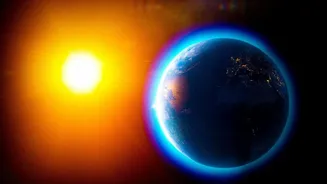
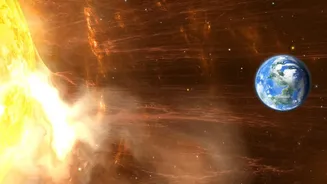
A solar storm is a major disturbance on the Sun, where it ejects a massive burst of plasma and magnetic fields. This event, known as a Coronal Mass Ejection (CME), sends a wave of charged particles hurtling through space. If Earth is in the path of a CME, our planet's magnetic field (the magnetosphere) gets jolted. This interaction is what triggers a geomagnetic storm, the phenomenon behind both the beautiful northern lights and the potential for technological chaos. Typically, space weather agencies can provide warnings hours or even days before a CME arrives, giving satellite operators and grid managers time to prepare. However, a new understanding of these events suggests our warning window may sometimes be dangerously small.
A New and Faster Threat
The core of the new findings is that the threat isn't just from the main cloud of solar material, but from the complex interactions that happen as it travels. The study highlights that the initial shockwave of a solar storm can cause rapid, severe magnetic field fluctuations on its own. These disturbances travel at or near the speed of light, meaning the time between detection and arrival on Earth can be as little as eight minutes. This is a dramatic departure from the one-to-three-day travel time we associate with the bulk of a CME. The disturbance causes what are known as geomagnetically induced currents (GICs) — essentially, rogue DC electricity flowing through the ground and into any long conductors, like power lines. The new research shows these GICs can be triggered almost instantaneously, leaving no time for human intervention.
Why Minutes Matter for the Grid
Our electrical grids are built for alternating current (AC). When a solar storm induces quasi-DC currents (GICs) into high-voltage transmission lines, it can cause transformers to overheat and saturate. This can lead to voltage instability, equipment damage, and trigger protective relays to trip, potentially causing cascading blackouts. The 1989 Quebec blackout, which left millions without power for nine hours, was caused by a powerful geomagnetic storm. Grid operators currently rely on warnings to take preventative measures, like reducing load on certain lines or preparing to manage voltage fluctuations. But if the warning shrinks from hours to minutes, these manual preparations become impossible. The only defence would be automated systems and a grid hardened to withstand the blow.
Is India's Grid at Risk?
India's geographic location offers a degree of natural protection. Being situated at lower geomagnetic latitudes means the country is less susceptible to the most severe GICs, which are typically concentrated near the poles. However, this doesn't mean the risk is zero. As India's reliance on technology and its power grid grows—with solar capacity alone reaching over 164 GW by mid-2026—so does its vulnerability. Intense solar activity can still disrupt satellite communications, GPS navigation, and aviation systems, all of which are critical to India's economy. Indian researchers and agencies like the Grid Controller of India and ISRO are actively monitoring space weather. ISRO's Aditya-L1 solar observatory, for instance, is a crucial tool providing real_time data to help safeguard India's assets in space and on the ground.
Preparing for a Cosmic Surprise
Mitigating this faster than expected threat requires a multi pronged approach. First is improving forecasting. Research, including work by Indian scientists, is focused on developing new methods to better predict the intensity and trajectory of solar storms. Second is grid resilience. This involves 'hardening' the infrastructure by installing devices like neutral blocking devices (NBDs) that can block GICs from damaging transformers. Some utilities in North America have already begun installing these as a pilot program. Finally, automated response systems that can react in seconds, rather than relying on human operators receiving a warning hours in advance, will become increasingly critical. As our world becomes more interconnected and dependent on a fragile electrical infrastructure, understanding and preparing for the Sun's most powerful outbursts is no longer an academic exercise, but a matter of national security and economic stability.