






A Climate Too Complex for Old Tools
For decades, weather forecasting has relied on complex physics-based models, known as numerical weather prediction (NWP). These models simulate the Earth's atmosphere using mathematical equations to project future weather. While revolutionary, they are
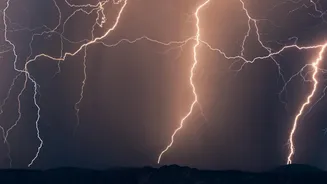
computationally expensive, sometimes taking hours on powerful supercomputers to generate a single forecast. In an era of accelerating climate change, where extreme weather events like intense heatwaves, sudden floods, and powerful cyclones are becoming more common, the limitations of these traditional methods are becoming apparent. They can struggle to capture the full scope of rare but catastrophic events, creating an urgent need for faster, more agile forecasting tools.
How Artificial Intelligence Offers New Hope
Enter artificial intelligence. Instead of solving physics equations from scratch, AI models, particularly a type called machine learning, learn directly from data. Scientists train these models on decades of historical weather observations, allowing the AI to identify subtle patterns and correlations that might be invisible to traditional analysis. Major tech companies and research institutions are now developing sophisticated AI weather models, such as Google's GraphCast and WeatherNext 2, and NVIDIA's Earth-2 platform. These models can process vast datasets and generate highly accurate 10-day forecasts in under a minute on a single computer, a task that would otherwise require a massive supercomputing cluster.
From Accurate Forecasts to Extreme Event Warnings
The practical applications of this technology are already making an impact. AI is significantly improving the accuracy of medium-range weather forecasts. For instance, Google's AI has shown it can outperform leading conventional forecasting systems on many metrics. Beyond general forecasts, AI excels at predicting low-probability, high-impact events. By running hundreds of possible weather scenarios quickly, these models are becoming crucial tools for issuing early warnings for cyclones, floods, and droughts, giving communities more time to prepare. This is especially vital in developing countries, where AI can help provide timely alerts and mitigate the impact on vulnerable populations.
The Indian Context: Monsoons and More
For India, a nation whose economy and food security are deeply intertwined with the monsoon, this technology holds immense promise. More accurate and timely predictions of the monsoon's onset, intensity, and distribution can revolutionize agricultural planning, water resource management, and disaster preparedness. AI's ability to provide localized, high-resolution forecasts could help farmers make better decisions about planting and irrigation, while also helping authorities manage reservoirs more effectively to prevent both droughts and floods. Furthermore, as India grapples with increasingly severe heatwaves, AI-driven early warning systems can play a life-saving role in public health responses.
A Tool, Not a Magic Bullet
Despite its power, AI is not a perfect solution. A significant challenge is the 'black box' problem, where complex models can make predictions without scientists fully understanding the underlying reasoning, making it difficult for policymakers to trust and act on the outputs. Some studies also suggest that while AI models are excellent at predicting known patterns, they may underperform when it comes to forecasting unprecedented, record-breaking extreme weather events that fall outside their training data. Moreover, the massive data centers required to train and run these advanced AI systems consume significant amounts of energy and water, raising environmental concerns that must be addressed to ensure the solutions don't contribute to the problem they aim to solve.