





What Exactly Happened on July 5?
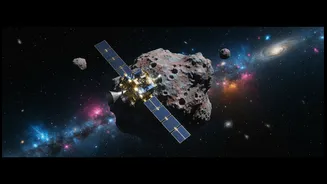
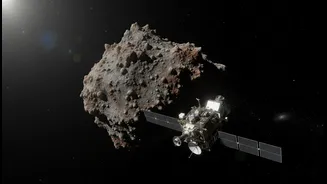
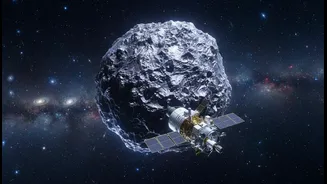
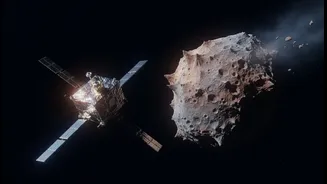
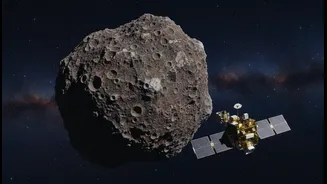
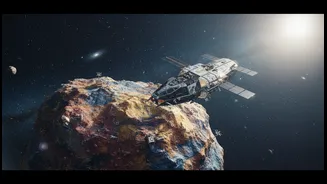
On July 5, 2026, the Japan Aerospace Exploration Agency (JAXA) guided its veteran Hayabusa2 spacecraft past a near-Earth asteroid named Torifune. The probe passed the asteroid at a relative speed of about 5 kilometers per second, or roughly 18,000 kilometers per hour.
This was not a leisurely orbit, but a fleeting, high-stakes encounter. The flyby was part of Hayabusa2's extended mission, which began after it successfully delivered samples from the asteroid Ryugu to Earth in 2020. Instead of retiring the successful probe, JAXA sent it on a new journey, with the Torifune encounter serving as a key scientific and technical objective. The event was a test of precision navigation and a valuable opportunity to study a new type of asteroid up close.
Meet the Spacecraft: Hayabusa2
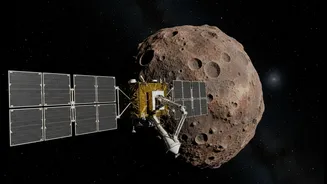
Hayabusa2 is one of JAXA's most celebrated probes. Originally launched in 2014, its primary mission was to rendezvous with asteroid Ryugu, collect surface samples, and return them to Earth. It achieved this spectacularly, and the returned samples have provided incredible insights into the building blocks of our solar system. The spacecraft is equipped with a suite of scientific instruments, including optical navigation cameras (ONC-T), a thermal infrared imager (TIR), and a near-infrared spectrometer (NIRS3). While designed for rendezvous missions involving long-term orbital stays, the Torifune flyby challenged mission controllers to adapt Hayabusa2 for a high-speed encounter—a task it performed flawlessly.
The Target: Asteroid Torifune
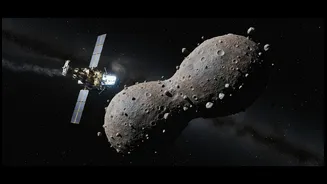
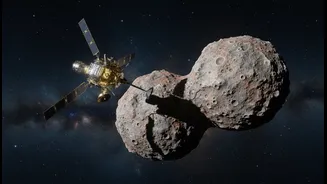
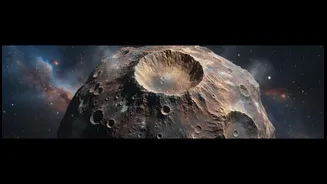
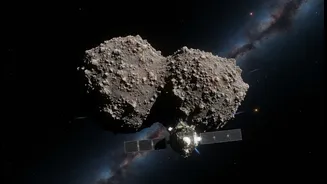
Torifune, also known as 2001 CC21, is a near-Earth asteroid with a diameter of about 450 meters. Before the flyby, observations suggested it was an S-type asteroid, meaning it is primarily made of stony silicate materials. The images captured during the encounter on July 5 revealed a fascinating structure: Torifune is a 'contact binary,' appearing like two separate objects that have gently merged, giving it a snowman-like shape. This structure provides planetary scientists with a natural laboratory for understanding how smaller bodies in the solar system can come together to form larger objects. The close-up images and thermal data are now being analyzed to understand its surface composition, temperature variations, and physical properties.
Why This Flyby Is Important
This mission serves several crucial purposes. Scientifically, it provides the first-ever close-up look at this specific type of contact-binary asteroid, offering clues about planetary formation. Technologically, successfully navigating a high-speed flyby with a craft not originally designed for it is a major engineering achievement for JAXA. Furthermore, the mission has significant implications for planetary defense. By practicing the skills needed to precisely intercept a small, fast-moving object, JAXA is honing capabilities that could one day be used to monitor or even deflect an asteroid found to be on a collision course with Earth. Asteroids the size of Torifune are large enough to cause significant damage, making the study of such objects a global priority.
What's Next for Hayabusa2?
The Torifune encounter was just one stop on a much longer journey. With this flyby complete, Hayabusa2 continues its voyage through the solar system. Its ultimate destination is a rendezvous with an even smaller, more challenging target: a tiny asteroid named 1998 KY26. The probe is scheduled to arrive there in July 2031. That asteroid is estimated to be only about 30 meters in diameter, and exploring such a small body at close range will be another world-first. The data and experience gained from the Torifune flyby will be invaluable in preparing for that final, ambitious encounter, further extending the legacy of one of history's most successful asteroid missions.