








What is the Artemis Program?
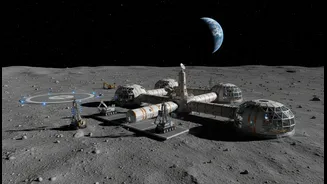
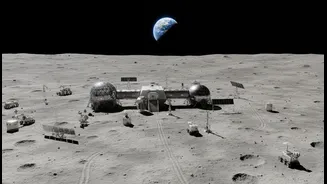
Think of the Artemis program as humanity's next giant leap. Led by NASA, it's a huge international effort to return astronauts to the Moon. But this time, it's different from the Apollo missions of the 1960s and '70s. The goal isn't just to leave footprints
and flags. It's to build a long-term home on the Moon, called the Artemis Base Camp. This program is also special because it will land the first woman and the first person of colour on the lunar surface, showing that space is for everyone. The name 'Artemis' comes from Greek mythology; she was the goddess of the Moon and the twin sister of Apollo.
A Science Lab on the Moon
So, why build a base on the Moon? The primary reason is science. The Moon is like a 4.5-billion-year-old time capsule of our solar system's history. By studying its rocks and geology, scientists can understand how Earth and other planets were formed. Astronauts will act as field geologists, collecting samples from areas humans have never been to before, like the lunar South Pole. They'll also set up long-term experiments on the surface. Imagine a science lab, but instead of being on Earth, it's a quarter of a million miles away. This will allow for unique studies in physics, astronomy, and planetary science that simply aren't possible from here.
The Search for Water Ice
One of the most exciting scientific goals is the hunt for water ice. The Moon's South Pole has craters that have been in permanent shadow for billions of years. Scientists believe these dark, freezing craters could hold vast amounts of frozen water. Finding water is crucial for two big reasons. First, it tells us about the history of water in our solar system. Second, water is a critical resource for a lunar base. It can be used for drinking, growing plants, and, when split into hydrogen and oxygen, can create breathable air and even rocket fuel. Finding local resources means future missions won't have to carry everything from Earth.
How Will They Build It?
Building a base on the Moon is a massive engineering challenge. The plan involves multiple phases. First, robotic missions and early astronaut crews will deliver equipment like rovers, habitats, and power systems. NASA is working with private companies like SpaceX and Blue Origin to build the landers that will carry crew and cargo to the surface. The base itself will be built up over time, starting with mobile habitats and eventually growing to include permanent structures, a power grid, and communications networks. The goal is to create a 'semi-permanent' presence, allowing astronauts to stay for longer periods to conduct their important work.
India's Connection to the Moon Mission
This isn't just an American mission; it's a global one, and India is a key partner. In 2023, India signed the Artemis Accords, a set of principles for peaceful and cooperative space exploration. This makes India part of the team shaping humanity's future on the Moon. While ISRO continues its own brilliant lunar program with missions like Chandrayaan, this partnership allows for valuable knowledge sharing. It ensures that technology developed by ISRO is compatible with international standards, opening the door for future joint missions to the Moon and beyond. The success of Artemis strengthens a global space infrastructure where India is a respected stakeholder.
A Stepping Stone to Mars
Ultimately, everything NASA learns on the Moon—how to protect astronauts from radiation, how to use local resources, and how to live and work on another world—is practice for an even bigger goal: sending humans to Mars. The Moon is a challenging but relatively close testing ground. Living on the Moon for months will prepare astronauts for the years-long journey to the Red Planet. The Artemis Base Camp isn't just about exploring our nearest celestial neighbour; it's the first step in humanity's journey to becoming a multi-planetary species.