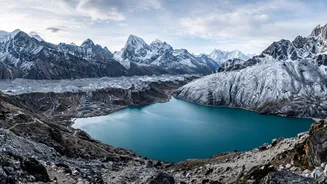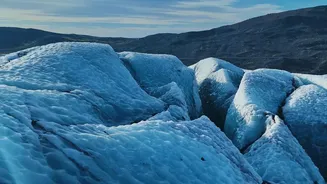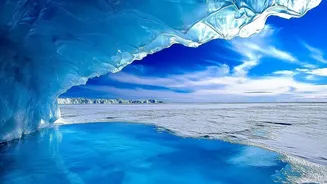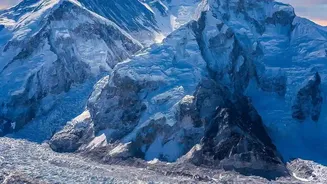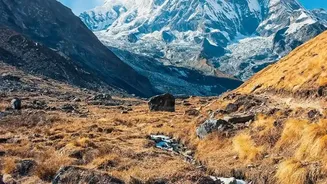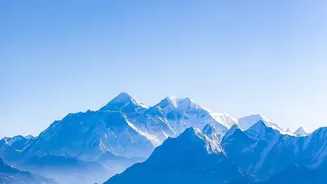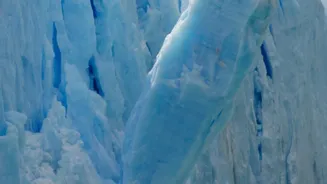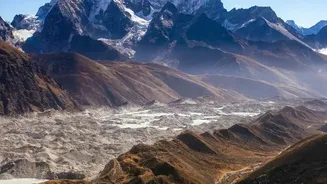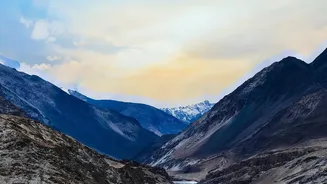





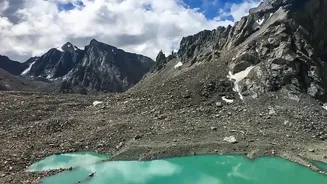
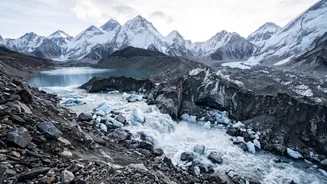
High in the Himalayas, the vast reserves of ice often called the ‘Third Pole’ are melting at an alarming rate. Recent UN reports highlight a terrifying consequence: a growing risk of catastrophic glacial floods threatening millions downstream.
A Clear and Present Danger
Recent warnings
from United Nations-backed reports and officials paint a stark picture of the escalating dangers in the Hindu Kush Himalaya region. Reports like 'State of the Cryosphere 2026', released just ahead of the COP31 climate summit, confirm that these frozen landscapes are warming much faster than the global average. For example, a global temperature rise of 1.5°C could mean an average warming of up to 2.2°C in the Himalayas. This accelerated warming is causing glaciers to retreat rapidly, leading to the formation of unstable glacial lakes and increasing the frequency and intensity of a phenomenon known as Glacial Lake Outburst Floods (GLOFs). Following recent devastating floods in Nepal, a senior UN official warned that entire riverbanks where millions of people live might become 'effectively uninhabitable'.
What Is a Glacial Lake Outburst Flood?
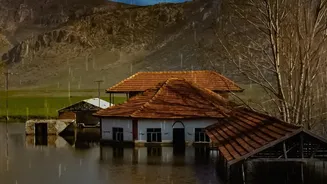
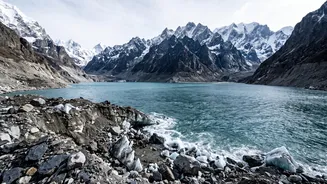
A GLOF is a sudden and violent flood that occurs when the natural dam containing a glacial lake fails. These lakes form as glaciers melt, with the water often held back by unstable barriers of loose rock and ice called moraines. As temperatures rise, the lakes swell with meltwater, putting immense pressure on these fragile dams. A trigger, which could be anything from an ice avalanche to heavy rainfall or even a tremor, can cause the dam to breach. When this happens, a massive volume of water, mud, and boulders is unleashed downstream with incredible force, destroying everything in its path—villages, roads, bridges, and vital infrastructure like hydropower plants. These events have become about five times more frequent since 1950.
The Human Cost in a Vulnerable Region
The threat is not abstract; it is a lived reality for a huge portion of Asia's population. The great river systems of the Indus, Ganges, and Brahmaputra originate in the Himalayas, supporting the water, food, and energy needs of nearly two billion people. According to a UN-led study, India has suffered the highest number of deaths from GLOFs in the Hindu Kush Himalaya region between 1835 and 2025, with over 6,000 fatalities recorded. These floods not only pose an immediate risk to life but also threaten long-term security. They can cripple agriculture, which in many parts of northern India is heavily dependent on glacier-fed river water for irrigation. The increasing sediment load from melting glaciers also damages hydropower infrastructure, a critical energy source for the region.
A Paradoxical Water Crisis
The melting glaciers create a cruel paradox. In the short term, the increased meltwater can lead to higher river flows and devastating floods. Recent reports from the World Meteorological Organization (WMO) note that river discharge in South and Southeast Asia was above normal in 2025, contributing to flood risk. However, in the long term, as glaciers shrink and their water storage capacity vanishes, the dependable flow of water into these rivers will decline. This will lead to severe water scarcity, particularly during dry seasons, threatening both drinking water supplies and agricultural output for hundreds of millions of people. Northern India has already recorded below-normal water storage and groundwater deficits, highlighting that high river flow today does not guarantee water security tomorrow.
From Warning to Coordinated Action
In response to the growing threat, UN agencies and international partners are focusing on risk reduction. Projects led by the UNDP are underway in countries like Nepal and Pakistan to mitigate GLOF risks. These initiatives focus on installing early warning systems, creating hazard maps, and in some cases, implementing engineering solutions like the controlled draining of highndrisk lakes. For example, a project in Nepal aims to lower the water levels in four highndpriority glacial lakes and build capacity to manage future risks, directly benefiting over 385,000 people. Experts emphasize that crossborder cooperation is critical, as many of the river basins and GLOF risks are transboundary. Timely warnings from Bhutan have recently triggered alerts in West Bengal and Assam, demonstrating the value of such collaboration.