



A Planet Hunter's Day Job
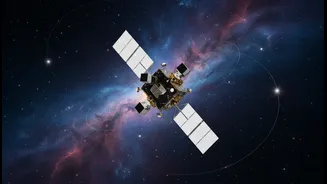
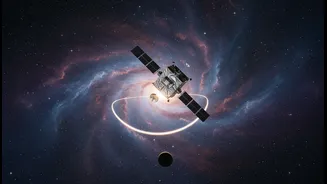
NASA’s Transiting Exoplanet Survey Satellite, or TESS, has a straightforward primary mission: to find planets outside our solar system. It does this using a technique called the transit method. TESS stares intently at vast patches of the sky, monitoring
hundreds of thousands of stars for tiny, periodic dips in their brightness. A slight dimming can indicate that a planet is passing in front of its star from our point of view, casting a miniature shadow. This method is incredibly effective and has found the majority of the thousands of exoplanets we now know exist. However, it’s most effective at finding very large planets that orbit very close to their parent stars, as these produce the most noticeable and frequent dips in light. Worlds that are smaller or farther out, like the planets in our own solar system, are much harder to spot this way.
The Cosmic Magnifying Glass
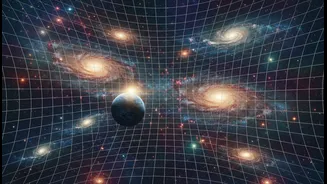
There is another, more exotic way to find planets, one predicted by Albert Einstein over a century ago: gravitational microlensing. His theory of general relativity tells us that massive objects warp the fabric of space-time. When a star with a planet passes precisely in front of a much more distant star, its gravity acts like a cosmic magnifying glass. This 'lens' bends and amplifies the light from the background star, causing it to temporarily brighten. If the foreground star has a planet, the planet’s own smaller gravity adds a second, brief spike of brightness to the event. This method is powerful because it can detect planets at immense distances—thousands of light-years away—and is especially sensitive to planets with large orbits, similar to Jupiter or Saturn in our own solar system. The major drawback is that these alignments are rare, random, and never repeat.
An Unexpected Discovery
The surprise came when scientists found that TESS, a master of the transit method, had accidentally captured a perfect microlensing event. The first hint of a new planet, now named Gaia23bra b, came in 2023 from data collected by the European Space Agency's Gaia telescope, which flagged a star that was briefly brightening. When researchers went back through TESS's archived data, they found it had been watching that same patch of sky. While Gaia's observations were too infrequent to confirm a planet, TESS's more continuous coverage clearly showed the tell-tale secondary spike in brightness caused by a planetary companion. This was a stunning discovery. No one expected TESS, which looks for dimming stars within a few hundred light-years, to be capable of spotting a planet nearly 40,000 light-years away using a completely different physical principle.
Rewriting the Exoplanet Rulebook
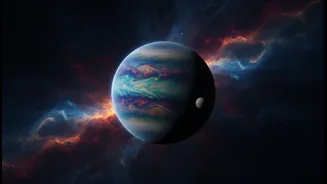
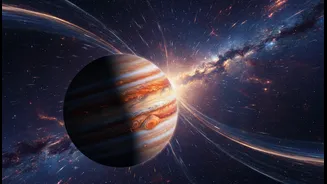
The planet TESS found, Gaia23bra b, is a gas giant about 1.6 times the mass of Jupiter, orbiting its star at a distance similar to Jupiter's orbit around our sun. This is precisely the type of planet the transit method is likely to miss. The discovery proves that TESS is a dual-threat planet hunter, capable of executing two complementary techniques. The transit method finds close-in planets and tells us their size, while microlensing finds distant planets and tells us their mass and orbital distance. Using both methods gives astronomers a more complete picture of planetary systems. Scientists now believe there are likely more of these microlensing discoveries hiding in TESS's vast archives, just waiting to be found.
A Preview of the Future
This accidental discovery serves as a thrilling preview for NASA's next-generation Nancy Grace Roman Space Telescope, set to launch in the coming years. One of Roman's primary goals is to use gravitational microlensing to conduct a massive survey of the galactic core, where the high density of stars makes these events more common. Roman is expected to find thousands of new worlds this way, including planets as small as Mars and even free-floating 'rogue' planets that don't orbit a star at all. The unexpected success of TESS shows the power of the technique and builds excitement for what Roman will uncover. By combining TESS's views of the wider galaxy with Roman's deep dive into its core, we are entering a new era of understanding how planets, including ones like our own, form across the Milky Way.