



An Ocean World Full of Promise
Europa is a world of incredible potential. Though smaller than Earth's moon, it is one of the most compelling places to search for life beyond our planet. Scientists have strong evidence that a global ocean of salty liquid water is hidden beneath its
miles-thick ice crust. This ocean is kept from freezing solid by the immense gravitational tug-of-war between Europa and its parent planet, Jupiter. This constant flexing, known as tidal heating, warms the moon's interior and could create hydrothermal vents on the ocean floor. On Earth, similar vents in the deep, dark sea floor teem with life, supporting entire ecosystems without any sunlight. The tantalizing possibility is that Europa’s ocean could harbor a similar environment, complete with the three ingredients thought to be essential for life: liquid water, the right chemical elements, and a source of energy.
The Challenge: How to Search from Orbit
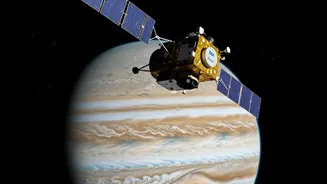
Confirming life hundreds of millions of miles away is a monumental task, made even harder by the fact that the Europa Clipper mission will not actually land on the moon. Drilling through an ice shell that could be over 25 kilometers thick is far beyond our current robotic capabilities. Instead, the spacecraft will make dozens of close flybys, some swooping just 25 kilometers above the frozen surface. So how can it detect life from orbit? The answer lies in tasting what Europa ejects into space. Scientists believe that plumes of water vapor may erupt from Europa's surface, similar to geysers on Earth, carrying material from the subsurface ocean with them. Even without active plumes, the constant bombardment of tiny meteorites on Europa's surface kicks up a cloud of ice and dust. The Clipper is designed to fly through this material and analyze it directly.
The Robotic 'Nose' and 'Tongue'
To analyze this ejected material, the Clipper is equipped with a suite of highly sensitive instruments. The two key players in the search for life are the SUrface Dust Analyzer (SUDA) and the MAss Spectrometer for Planetary EXploration (MASPEX). Think of them as the spacecraft’s tongue and nose. SUDA will collect and analyze tiny grains of ice and dust, determining their chemical composition. Recent laboratory studies suggest that even a single ice grain could contain detectable evidence of cellular material if life exists. MASPEX, meanwhile, will sniff the gases in Europa’s extremely thin atmosphere and any plumes it encounters. It is so precise it can tell the difference between molecules with nearly identical masses, a crucial ability for identifying complex organic compounds that could be signs of biological processes.
Building a Case for Life
NASA is clear that Clipper is not technically a life-detection mission; its primary goal is to assess Europa's habitability. Confirmation of life will not come from a single measurement but from building a convincing chain of evidence. Finding a biosignature—a substance or phenomenon that provides evidence of past or present life—is the goal. This means other instruments must provide context. The REASON radar will probe the ice shell to confirm the ocean's existence and locate pockets of trapped water. The ICEMAG magnetometer will measure the ocean's depth and salinity. These instruments will confirm the environment is suitable for life. Then, if SUDA and MASPEX find complex organic molecules, specific amino acids, or lipids within the plumes, the case becomes much stronger. The ultimate prize would be detecting chemical or isotopic patterns that are difficult to explain without biology, providing the strongest evidence yet that we are not alone in the solar system.