






The Unreachable Cosmic Engines
Black holes, especially those that are spinning, are immense reservoirs of energy. For over half a century, physicists have theorized that it should be possible to tap into this power. In 1969, the renowned physicist Sir Roger Penrose proposed that an
object entering the strange region around a rotating black hole, called the ergosphere, could split in two. One part would fall into the black hole, while the other would be flung out with more energy than the original object had. This cosmic sleight of hand would effectively steal a tiny fraction of the black hole’s rotational energy. A couple of years later, Yakov Zel'dovich expanded on this, suggesting that waves—not just particles—could also be amplified if they bounced off a rapidly rotating object. The problem? Proving it has been impossible. We can't travel to a black hole, and recreating the necessary conditions on Earth by physically spinning an object would require speeds so high that any known material would be torn apart.
Building a Black Hole Analogue
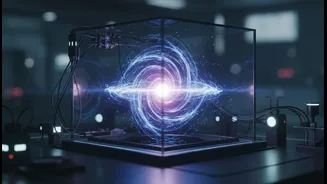
When a cosmic phenomenon is too distant or extreme to study directly, scientists get creative by building 'analogues' in the lab. These are systems that follow the same mathematical rules, even if they are made of completely different things. Previous experiments have used water vortices and sound waves to mimic certain black hole properties. Recently, however, researchers at the Advanced Science Research Center at the CUNY Graduate Center took a groundbreaking new approach. Instead of using a physically spinning object, they constructed a stationary ring of electronic resonators. This device, made of special engineered materials called metamaterials, could do something extraordinary. By precisely controlling the electronic properties of the resonators in a timed sequence that travelled around the ring, they created what they call "synthetic rotation." To any wave sent through it, the device behaved as if it were spinning at an impossibly fast speed, without a single part actually moving.
Making Waves to Steal Energy
With their tabletop black hole analogue ready, the team put Zel'dovich's theory to the test. They sent radio-frequency waves into the non-moving, yet synthetically rotating, device. The results, published in the journal Nature, were a stunning confirmation of the half-century-old prediction. Waves with the correct rotational properties interacted with the system and emerged on the other side amplified, having extracted energy from the synthetic rotation. Co-lead author Hady Moussa confirmed that the experiment successfully reproduced the essential physics of what is known as the Penrose-Zel'dovich process. The clever use of modulated electronics to simulate rotation sidestepped the physical limitations of mechanical speed, allowing the researchers to probe an extreme regime of physics that was previously only theoretical.
Why This Lab Experiment Matters
While this breakthrough doesn't mean we'll be powering our cities with mini black holes anytime soon, its implications are profound. First, it provides a tangible, controllable way to study the bizarre physics of the ergosphere, one of the most extreme environments in the universe. It moves a fascinating concept from pure theory into the realm of practical experimentation. Second, the technology itself has significant potential. The ability to selectively amplify waves based on their rotational properties could lead to new advancements in wireless communications, radar technology, and optics. Principal investigator Andrea Alù noted that the approach facilitates a new method of wave-matter interaction, producing a form of selective amplification. By creating a platform to test these cosmic theories safely on a lab bench, scientists can explore new ideas in astrophysics, wave physics, and even quantum science.