







India's Living Wall of Defence
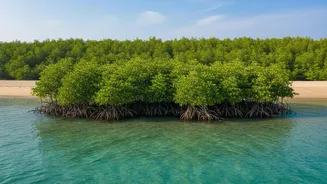
Stretching along the Bay of Bengal, from the vast Sundarbans in West Bengal to the Bhitarkanika forest in Odisha and the Pichavaram mangroves in Tamil Nadu, is a formidable natural fortress. These unique coastal forests, comprised of salt-tolerant trees
and shrubs known as halophytes, thrive in the challenging intertidal zone where land meets sea. They form a critical buffer, acting as a 'bio-shield' that protects vulnerable coastal communities from the raw power of nature. With a total cover of nearly 5,000 square kilometres, these ecosystems are India's first line of defence against the increasingly frequent and ferocious storms that form in the bay.
The Science of the Natural Barrier
The protective power of mangroves lies in their remarkable and complex structure. Their dense, tangled root systems—including stilt roots, prop roots, and breathing roots called pneumatophores—anchor them firmly in the soft, muddy soil. This intricate network acts like a giant net, trapping sediment, stabilising the coastline, and preventing erosion. When a storm surge approaches, this underwater web, combined with the sheer number of sturdy trunks, creates immense friction. This friction slows the flow of water and significantly dissipates wave energy, with studies suggesting that just 100 metres of mangrove forest can reduce wave energy by up to 66 percent. The dense canopy also helps to absorb and reduce high-velocity winds before they can reach inland areas.
Proven in the Eye of the Storm
The life-saving value of these green barriers is not theoretical. Evidence from past cyclones provides stark proof of their effectiveness. A landmark study following the 1999 Odisha super cyclone, which claimed an estimated 10,000 lives, found a direct correlation between mangrove cover and human survival. Villages sheltered by wider belts of mangroves experienced significantly fewer deaths than those with little or no forest cover. More recently, during Cyclone Amphan, officials noted that the Bhitarkanika National Park and nearby hamlets were largely spared from the storm's fury because the dense mangroves absorbed the impact. In these instances, the forests acted precisely as designed: a natural shield that blunted the storm's deadliest force.
More Than Just a Storm Buffer
While their role in storm protection is critical, the benefits of mangroves extend far beyond disaster mitigation. These ecosystems are biodiversity hotspots and act as crucial nursery grounds for countless species of fish, crabs, and prawns, supporting the livelihoods of coastal fishing communities. They also improve water quality by filtering pollutants and trapping heavy metals. Furthermore, mangroves are carbon sequestration powerhouses, storing vast amounts of carbon in their biomass and soil, which helps combat climate change. The Sundarbans, the world's largest mangrove forest, are a prime example of this, providing not only protection but also vital resources for millions of people.
A Fraying and Threatened Shield
Despite their immense value, India's mangrove forests are under constant threat. Over the past decades, significant areas have been lost to deforestation for agriculture, aquaculture (shrimp farming), and unchecked urban expansion. Pollution from industrial and agricultural runoff disrupts the delicate saline balance these trees need to survive, while rising sea levels and increased storm intensity due to climate change put even healthy forests under immense pressure. The loss of these ecosystems not only exposes coastal communities to greater danger from storms but also destroys critical habitats and releases vast quantities of stored carbon back into the atmosphere. According to some reports, India has seen a slight decline in its total mangrove cover in recent years.