

ISRO's Next Giant Leap
Following the resounding successes of the Chandrayaan lunar missions and the Mars Orbiter Mission (Mangalyaan), the Indian Space Research Organisation (ISRO) has firmly established itself as a major player in interplanetary exploration. Buoyed by these
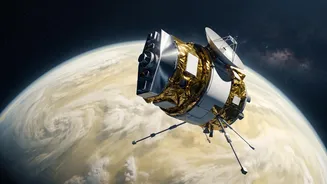
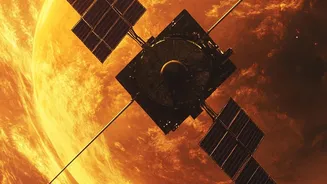
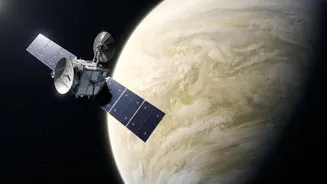
historic achievements, India is now setting its sights on a new, even more challenging frontier: the planet Venus. The Venus Orbiter Mission, named Shukrayaan, represents the natural evolution of India's space science program. Formally approved by the Union Cabinet in September 2024 with a launch planned for March 2028, this mission is not just another feather in ISRO's cap; it's a testament to the nation's growing capabilities and scientific curiosity. Shukrayaan marks India's second interplanetary venture and signifies a bold step towards understanding the most inhospitable planet in our solar system.
Why Venus? Earth's 'Evil Twin'
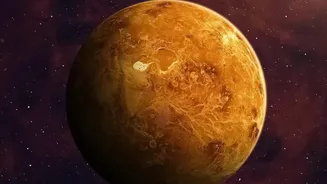
Venus is often called Earth's twin, and for good reason. It is nearly identical in size, mass, and density. Yet, despite these similarities, Venus is a hellish world. It's the hottest planet in the solar system, with surface temperatures high enough to melt lead, an atmospheric pressure over 90 times that of Earth's, and skies filled with clouds of corrosive sulfuric acid. Scientists believe Venus suffered a runaway greenhouse effect, transforming it from a potentially habitable world into its current toxic state. Understanding why and how Earth's twin had such a catastrophic divergence is a key scientific objective. Studying Venus provides a natural laboratory for climate change, offering critical insights that could help us better model and protect Earth's own climate future.
Peering Beneath the Poisonous Veil
The greatest challenge in studying Venus is its thick, opaque atmosphere. For decades, these dense clouds of sulfuric acid have hidden the planet's surface from direct observation, making it a world of mystery. The headline feature of the Shukrayaan mission is its advanced suite of sensors designed specifically to peer through this veil and study the dynamics below. Unlike missions that focus solely on the upper atmosphere, ISRO's orbiter will employ sophisticated radar technology to map the Venusian surface in unprecedented detail and even probe what lies just beneath it. This will allow scientists to search for signs of active volcanoes, chart geological features, and understand the processes that have shaped this enigmatic world over billions of years.
A Toolkit for an Alien World
To accomplish its ambitious goals, Shukrayaan will carry a payload of around 19 scientific instruments, a mix of Indian-developed and international collaborative hardware. The centerpiece of its sensor package is a high-resolution Synthetic Aperture Radar (SAR), which can pierce the clouds to create detailed surface maps regardless of weather or time of day. Perhaps most excitingly, it will also carry a ground-penetrating radar, a first for any Venus mission, which will study the shallow subsurface stratigraphy—the layering of rock and soil just below the ground. Other instruments, including a thermal camera and spectrometers, will analyse the atmospheric composition, hunt for volcanic gases, study the planet's interaction with the solar wind, and even investigate the potential for microbial life indicators like phosphine gas.
The Global Race Back to Venus
ISRO is not alone in its renewed interest in Venus. After decades of being overshadowed by Mars, the second planet from the sun is becoming a popular destination again. NASA has its own missions planned, including VERITAS, which will map the surface, and DAVINCI, which will drop a probe through the atmosphere. Europe's space agency, ESA, also has a mission called EnVision slated for the 2030s. Shukrayaan's planned 2028 launch positions India at the forefront of this new wave of Venusian exploration. The mission also features significant international collaboration, with instruments provided by Sweden, Russia, and Germany, highlighting India's role as a trusted partner in global space science.