




Squats and lunges are cornerstones of any good leg day, celebrated for their ability to build powerful thighs. But if you wobble, tilt, or feel unsteady, you're not just losing balance—you're losing the benefits and risking injury.
Why Balance Is The Unseen Rep
Balance is more than
just not falling over; it’s a critical component of effective exercise. When you are stable, your body can recruit the correct muscles for the job. For squats and lunges, this means your quadriceps and glutes do the heavy lifting, leading to stronger thighs. Poor balance forces smaller, less-equipped stabiliser muscles to work overtime, increasing your risk of strain and injury. It also means the target muscles aren't getting the full benefit of the movement. Mastering stability ensures every repetition is a quality one, translating to better results and safer workouts.
Mastering The Squat: Your Foundation
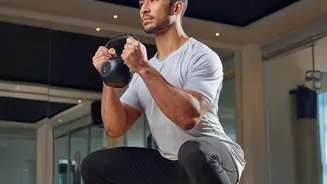
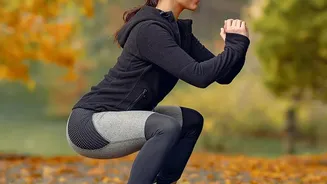
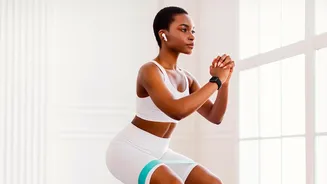
Think of a squat as sitting back into an invisible chair. Stand with your feet about shoulder-width apart, with your toes pointing slightly outwards. Keep your chest lifted and your back in a natural, straight line. Activate your core muscles to support your spine. Begin the movement by hinging at your hips and pushing your butt backwards, then bend your knees to lower your body. Aim to get your thighs at least parallel to the floor, ensuring your weight is concentrated on your heels, not your toes. Your knees should track in line with your feet and not drift inward. Push through your heels to return to the starting position.
Correcting Common Squat Imbalances
Many people struggle with balance during squats for a few key reasons. One common mistake is lifting the heels off the ground, which shifts weight forward onto the knees and can indicate tight ankles or a weak core. Another is letting the knees collapse inward, a sign of weak glute muscles. Leaning too far forward is also a frequent issue, often caused by tight hips or not initiating the movement by pushing the hips back. To fix these, try practicing squats facing a wall to prevent leaning forward, or perform them by lowering yourself onto a chair to master the 'sitting back' motion and build confidence. Placing a resistance band around your knees can also provide a physical cue to push them outward, activating the correct muscles.
Perfecting The Lunge: A Unilateral Challenge
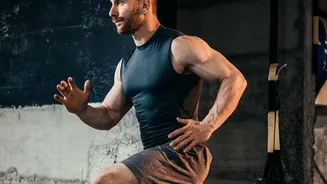
Lunges challenge your balance because they are a unilateral exercise, meaning they work one leg at a time. Start by standing with your feet hip-width apart. Take a generous step forward with one leg. It’s a common mistake to step one foot directly in front of the other as if on a tightrope; a wider, hip-width stance provides a more stable base. Lower your hips straight down until both knees are bent at approximately a 90-degree angle. Your front knee should be aligned over your ankle, not drifting past your toes, and your back knee should hover just above the floor. Keep your torso upright. Push off your front foot to return to the start.
Solving Lunge Instability
The notorious 'lunge wobble' often comes from a weak core or improper foot placement. If you feel unsteady, first check your stance. Ensure your feet are hip_width apart to create a solid base of support. Actively engage your core throughout the entire movement; this prevents your torso from tilting and helps stabilise your pelvis. Many people also make the mistake of stepping too far forward, which can put unnecessary pressure on the back knee. If you're new to lunges or struggle with balance, start with static or reverse lunges, as they require less coordination. You can also hold onto a wall or a sturdy chair for support as you build strength and control.
Drills to Build Your Base
To improve your stability for both squats and lunges, incorporate specific balance drills into your routine. Simple exercises like standing on one leg for 30 seconds can work wonders for your stability. You can make this more challenging by closing your eyes or standing on a less stable surface like a pillow. Heel_to_toe walks, where you walk in a straight line placing one foot directly in front of the other, also enhance coordination. Furthermore, strengthening your core with exercises like planks is essential, as a strong core is the anchor for all body movements. Regularly practicing these drills will translate into more controlled and powerful squats and lunges.