





Go for High-Transpiration Heroes
Some plants are better than others at adding moisture to the air through a process called transpiration. This increased humidity can be a secret weapon against particulate matter. Water droplets in the air can cause tiny pollution particles to clump together,
become heavier, and fall out of the air you breathe. Plants like the Areca Palm and Boston Fern are excellent natural humidifiers. The Areca Palm, in particular, is often praised for its ability to release significant amounts of moisture while also filtering common chemical toxins. Placing these in a dry room not only helps the air but creates a more comfortable environment.
Maximise Leaf Surface Area
When it comes to trapping airborne particles, think of leaves as natural dust catchers. Plants with larger, denser, or more complex foliage offer more surface area for particulate matter to settle on. A study has even shown that adding foliage plants can reduce the accumulation of dust on other surfaces by up to 20%. Plants with broad, waxy, or even slightly hairy leaves can be particularly effective. Good examples include the popular Money Plant (Pothos), Rubber Plant, and Peace Lily. Common Ivy, with its sprawling leaves, is also known for having a large surface area ideal for this purpose. A dense collection of these plants can act as a living filter, physically trapping particles that would otherwise be floating in your living room.
The Wipe-Down is Non-Negotiable
This might be the most crucial hack of all: regularly clean your plants' leaves. A leaf coated in a layer of household dust cannot effectively photosynthesise, transpire, or trap more particles. Think of it like cleaning a filter. For residents in high-pollution zones like Delhi-NCR, this is essential. Once a week, gently wipe down the leaves of your plants with a damp cloth. This action physically removes the trapped pollutants from your home environment for good. Not only does this allow the plant to 'breathe' and work more efficiently, but it also ensures the particles it has collected are disposed of, rather than being dislodged back into the air.
Create a Dense 'Green Zone'
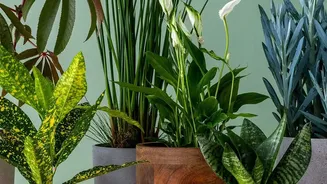
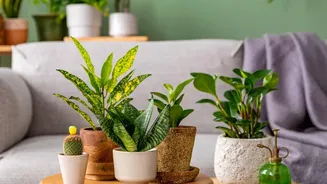
Instead of scattering single plants around your home, try clustering them together. Grouping several plants creates a 'micro-climate' with higher humidity and more collective power to capture pollutants. A dense green corner in your living room can be more effective than isolated pots. This strategy enhances the humidifying effect of plants like the Areca Palm and allows for a greater concentration of leaf surfaces working together. One study noted that a classroom with several potted plants saw a decrease in particulate matter concentrations of around 30%. Combine tall plants like palms with medium-sized ones like Snake Plants and smaller, bushier ones like Spider Plants to create a multi-layered defence.
Choose the Right Plants for the Job
While the famous 1989 NASA study focused on removing chemical gases (VOCs), some plants have also been studied for their ability to reduce particulate matter. Recent research has shown that certain common houseplants can effectively bind PM2.5. One study highlighted the Boston Fern (Nephrolepis exaltata) as a top performer. The Spider Plant (Chlorophytum comosum) has also demonstrated a significant ability to reduce particulate matter concentrations in indoor spaces. The Snake Plant (Sansevieria trifasciata) is another excellent choice; it's incredibly low-maintenance and uniquely releases oxygen at night, making it perfect for bedrooms.
Mind the Soil and Airflow
The air purification process isn't just about the leaves; microorganisms in the potting soil also play a role in breaking down certain pollutants. Some experts suggest that maximising airflow to the root and soil zone can enhance this effect. While you don't need a fan pointed at your pots, ensuring your plants aren't crammed into tight, airless corners can help. Healthy plants are always more effective air purifiers, so use good quality potting mix and ensure proper drainage to keep the root system thriving. Keeping the soil healthy means the entire plant system works more efficiently to keep your air clean.