
The Sun's Violent Outbursts
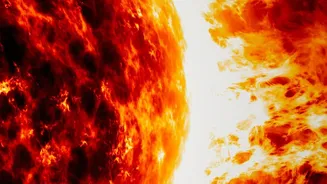
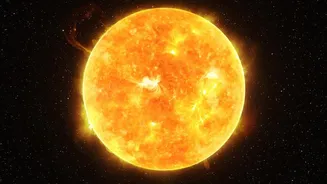
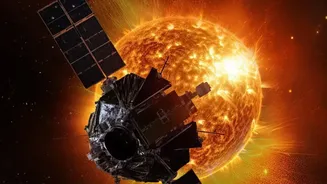
The Sun, our life-giving star, is not always calm. It has its own weather, which can be incredibly violent. Solar storms are powerful eruptions from the Sun's surface. The two main types are solar flares and coronal mass ejections (CMEs). Solar flares are intense
bursts of radiation that travel at the speed of light, reaching Earth in about eight minutes. They are like giant flashes that can disrupt radio communications. CMEs are even more powerful: enormous bubbles of plasma and magnetic fields that burst from the Sun, hurling billions of tonnes of material into space. If a CME is aimed at Earth, it travels for one to three days before slamming into our planet's magnetic field, triggering what is known as a geomagnetic storm.
Our Vulnerable Power Grid
While Earth's magnetic field protects humans from the direct effects of this solar radiation, our technological infrastructure is not so safe. A strong geomagnetic storm can induce powerful electrical currents in long conductors on the ground. This includes our vast networks of power transmission lines. These geomagnetically induced currents can flow into electrical transformers, causing them to overheat, and in a worst-case scenario, fail catastrophically. Such an event could trigger a cascading failure, leading to widespread and long-lasting blackouts. A famous example occurred in 1989, when a solar storm knocked out the entire power grid of Quebec, Canada, for nine hours.
Danger in Orbit
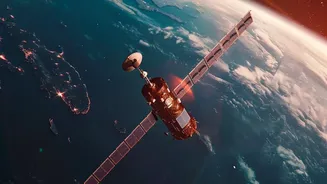
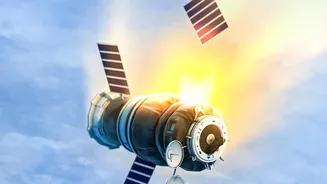
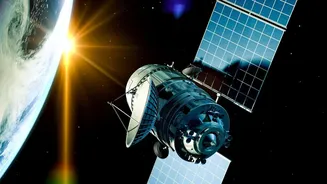
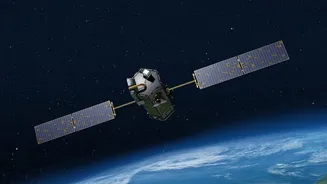
Above the atmosphere, the threat is just as severe. The thousands of satellites we depend on for GPS navigation, online banking, weather forecasting, and communications are directly in the line of fire. The high-energy particles from a solar storm can damage sensitive electronics and degrade solar panels, shortening a satellite’s lifespan. Furthermore, these storms heat and expand Earth's upper atmosphere. This increases the atmospheric drag on satellites in low-Earth orbit, causing them to slow down, lose altitude, and potentially burn up. Even a minor storm can force satellite operators to delay launches or re-route spacecraft.
The Eyes on the Sun
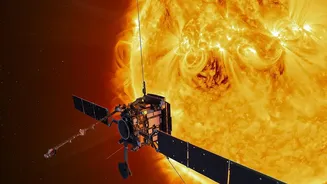
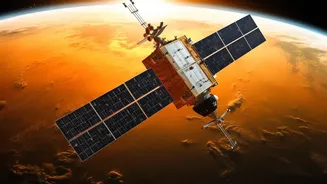
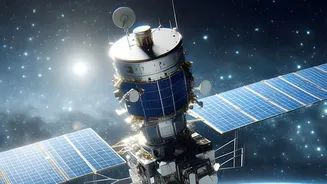
Given the risks, how do we defend ourselves? The first line of defense is a constant vigil. Agencies like the US National Oceanic and Atmospheric Administration (NOAA) operate a fleet of satellites specifically designed to monitor the Sun and the space environment. Key observatories, like the Deep Space Climate Observatory (DSCOVR), are positioned at a special point in space about 1.5 million kilometres from Earth, directly in the path of any incoming solar event. From this vantage point, they can detect the characteristics of a CME and give us a crucial heads-up—typically providing between 20 to 60 minutes of advance warning before the storm impacts our planet's magnetic field.
A Race Against Time
That short window of warning is vital. When an alert is issued by a space weather prediction centre, it triggers a flurry of defensive activity. Satellite operators can put their spacecraft into a protective 'safe mode', turning off sensitive electronics to prevent them from being fried by the incoming radiation. Power grid companies can take steps to protect their networks. They might reduce the load on the system, postpone non-essential maintenance, and bring backup generators online to stabilise the grid and prevent the induced currents from causing permanent damage to transformers. These pre-emptive actions, made possible only by continuous monitoring, are essential for mitigating the worst effects of a solar storm.