


The Cosmic Smoke Screen
Before we can appreciate the solution, we must understand the problem: cosmic dust. This isn’t the dust you find on your bookshelf. Instead, think of it as a kind of cosmic smoke, made of tiny particles of carbon and silicates. These particles, though
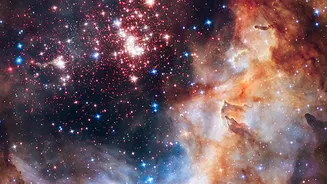
small, are incredibly effective at blocking and scattering visible light—the kind our eyes and telescopes like Hubble primarily see. For astronomers, this has meant that the most crucial moments in the universe's history, like the formation of the very first stars and galaxies, have been happening behind an opaque screen. These dense, dusty regions, known as molecular clouds, are the very places where new stars are born, collapsing under their own gravity. For decades, they remained largely mysterious, their inner workings hidden from view.
Webb’s Infrared Superpower
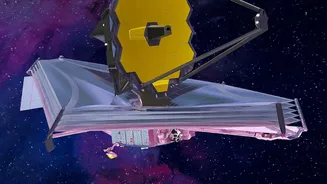
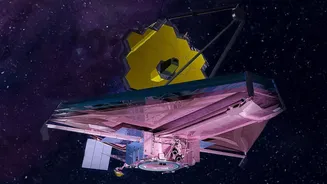
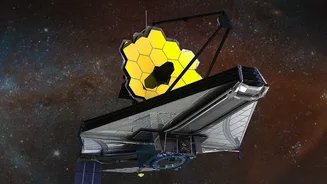
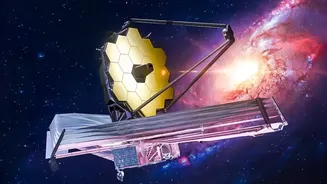
The James Webb Space Telescope (JWST) was engineered with a specific superpower to solve this exact problem: infrared vision. Infrared light has a longer wavelength than visible light. This simple fact is the key to its power. While the short, tight wavelengths of visible light are easily blocked by dust particles, the longer, stretched-out wavelengths of infrared light can slip past them much more easily. An astronomer once compared it to being in a smoky room; you can’t see through the smoke with your eyes, but an infrared camera could detect the heat of a person on the other side. In the same way, Webb’s instruments are designed to detect the infrared light—or heat—emitted by young, developing stars that is able to pass through the dusty cocoons that surround them. This allows JWST to see what was previously invisible.
The Technology Behind the Vision
This remarkable capability is made possible by a suite of highly advanced instruments. The two main stars of the show are the Near-Infrared Camera (NIRCam) and the Mid-Infrared Instrument (MIRI). NIRCam is Webb's primary imager, capturing near-infrared light to see through all but the thickest dust clouds. It’s responsible for many of the breathtakingly detailed images that show thousands of previously unseen newborn stars. MIRI, on the other hand, sees in the mid-infrared range, which allows it to peer into even denser, colder regions and observe cooler objects like the dusty disks where planets form. By using these instruments together, astronomers get a complete picture. NIRCam reveals the stars, and MIRI reveals the dust and gas structures, providing a holistic view of these dynamic environments.
Peeking Inside the Stellar Nurseries
With this new technology, astronomers are already rewriting our understanding of star formation. One of Webb's most iconic targets has been the Pillars of Creation, a region within the Eagle Nebula. Where Hubble saw majestic, but mostly opaque, columns of gas and dust, Webb has peered inside, revealing countless crimson-hued infant stars still forming within the pillars. In another region, the Tarantula Nebula, Webb’s infrared gaze uncovered tens of thousands of young stars that had been completely hidden. These observations are not just beautiful pictures; they provide invaluable data on how stars gather mass, how they interact with their surroundings, and how their formation is influenced by their environment. Recent discoveries have even found evidence of water and dust surviving in the extreme environment near the supermassive black hole at our galaxy's center, a process previously thought to be difficult.