





A Telescope Spanning Continents
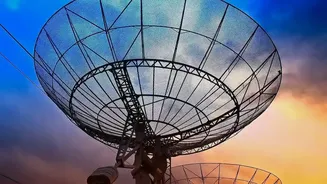
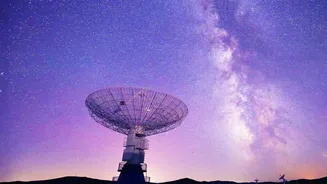
The tool for this incredible journey back in time is the Square Kilometre Array (SKA), an observatory of unprecedented scale and ambition. It is not a single instrument but a global collaboration to build the world's largest radio telescope. The project
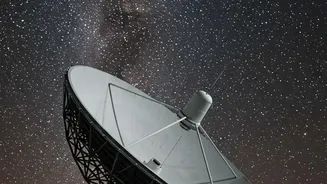
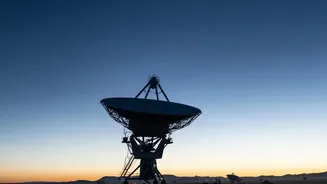
is spread across two remote locations to minimise radio interference from human activity. The SKA-Mid, an array of nearly 200 traditional dish antennas, is being built in South Africa's Karoo region. Meanwhile, the SKA-Low, consisting of over 131,000 small, tree-like antennas, is taking shape in Western Australia. When combined, these arrays will act as a single, gigantic telescope, with a total collecting area of one square kilometre. This immense scale will make the SKA exponentially more sensitive than any existing radio telescope, allowing it to detect signals that have been travelling across the cosmos for over 13 billion years. Construction began in 2022, and with milestones like the first dishes working in unison, the project is steadily moving from construction to the dawn of its own operational life.
Peering into the Cosmic Dawn
The primary target for this powerful new eye on the universe is a period known as the Cosmic Dawn. After the Big Bang, the universe was a hot, dense soup of particles. As it expanded and cooled over about 400,000 years, protons and electrons combined to form neutral hydrogen gas, plunging the cosmos into a period called the 'Dark Ages'. For millions of years, there were no stars to provide light. The Cosmic Dawn, which began a few hundred million years later, marks the end of this darkness. It was during this pivotal epoch that gravity pulled the primordial gas together to ignite the very first stars and form the earliest galaxies. The intense ultraviolet radiation from these first celestial objects began to burn through the neutral hydrogen fog, fundamentally changing the structure of the entire universe in a process called the 'Epoch of Reionisation'. Directly observing this transformative era is considered one of the final frontiers of modern cosmology.
The Ghostly Signal from the Past
So how can a radio telescope 'see' the first stars? The key lies in a faint signal emitted by the neutral hydrogen that dominated the early universe. This is known as the 21-centimetre signal, a low-frequency radio wave that hydrogen atoms release. While the signal itself is weak, the radiation from the first stars and galaxies dramatically affected the surrounding hydrogen, leaving a distinct imprint on this 21-cm signal. By capturing and mapping these faint, ancient radio waves—which have been stretched to longer wavelengths by the expansion of the universe over 13 billion years—astronomers can create a 3D map of the early cosmos. However, detecting this whisper from the past is an immense technical challenge. The signal is buried under radio 'noise' from our own galaxy and countless other cosmic sources that is orders of magnitude brighter. Isolating this precious signal is like trying to hear a pin drop in the middle of a rock concert, a task for which the SKA's extreme sensitivity was specifically designed.
India’s Crucial Role in the Quest
India is a key player in this global scientific endeavor. Having become a full member of the SKA Organisation, the country has committed ₹1,250 crore towards the construction, with the Department of Atomic Energy and the Department of Science and Technology jointly funding the effort. The National Centre for Radio Astrophysics (NCRA) in Pune is leading a consortium of more than 20 Indian research institutes involved in the project. Indian engineers and scientists have already made a landmark contribution by leading the design of the Telescope Manager, the highly complex software system that will serve as the 'brain' and 'nervous system' of the entire observatory, controlling and synchronising all its elements. Furthermore, India is contributing significantly to digital signal processing hardware for the SKA-Low telescope and is set to host a regional data centre, a critical node for processing the petabytes of data the SKA will generate. This involvement builds on decades of expertise from operating the Giant Metrewave Radio Telescope (GMRT) near Pune, a world-class facility that has served as an important technological and scientific pathfinder for the SKA.
What Awaits in the First Light?
The discoveries that await could revolutionise our understanding of the universe. By studying the Cosmic Dawn, scientists hope to answer some of the most fundamental questions in astrophysics. What were the first stars like? Known as Population III stars, these objects are theorised to have been hundreds of times more massive than our sun and composed almost entirely of hydrogen and helium. They lived fast and died young, seeding the universe with the first heavy elements. How did the first galaxies assemble and evolve? The SKA will map the distribution of gas and the formation of these nascent galaxies in unprecedented detail. It will also shed light on the nature of dark matter and dark energy, which governed the large-scale structure of this early cosmic web. The SKA is not just a telescope; it's a time machine. The insights gathered from observing the universe's infancy will provide a definitive chapter in the story of cosmic evolution, tracing the journey from a simple, dark universe to the complex, star-filled cosmos we see today.