




A Telescope the Size of a Continent
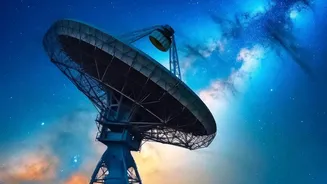
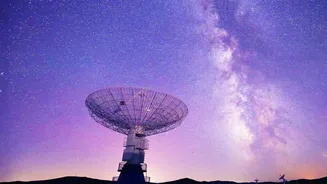
The Square Kilometre Array isn't a single telescope but a colossal network of thousands of antennas spread across two continents. Its name comes from the original goal of creating a total collecting area of one square kilometre. The project is co-hosted
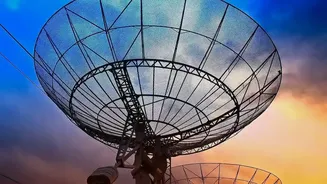
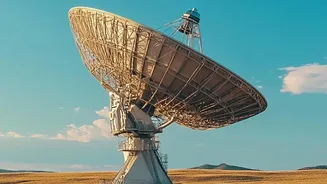
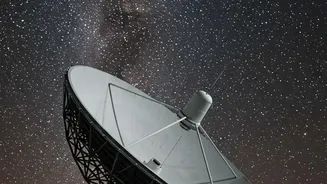
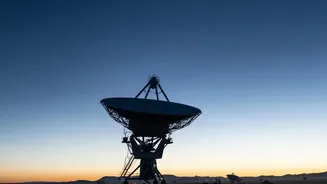
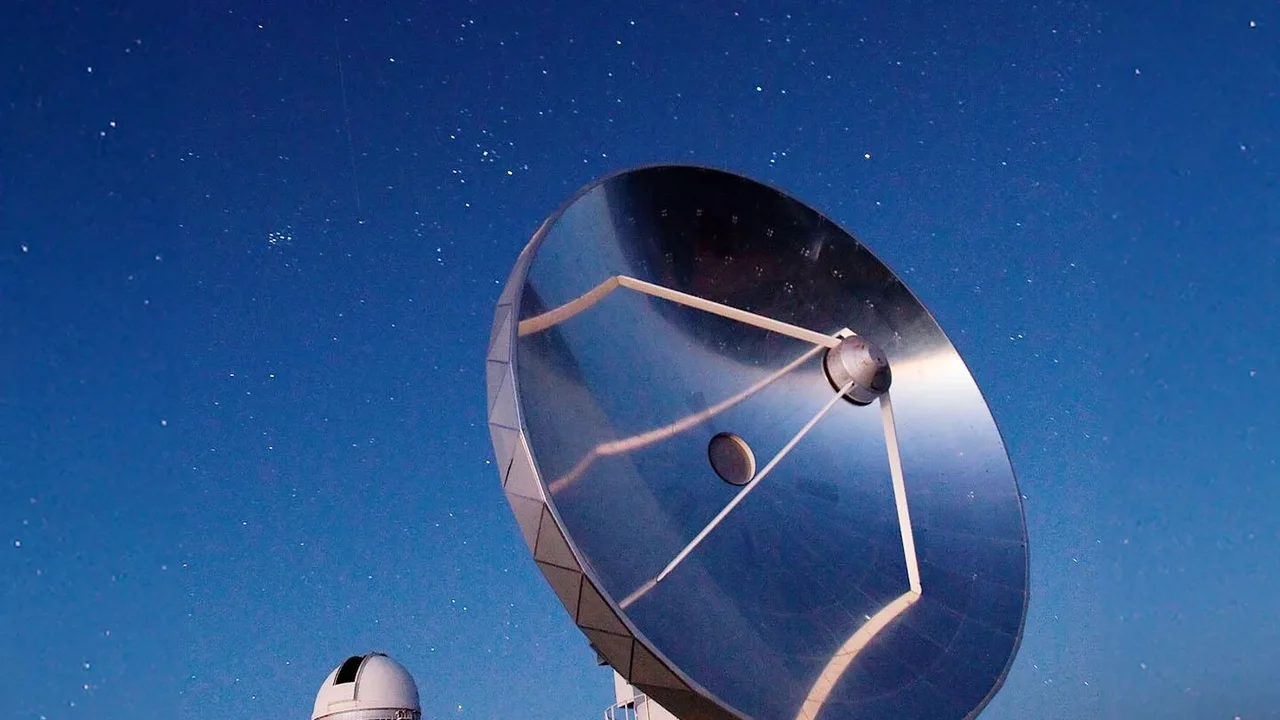
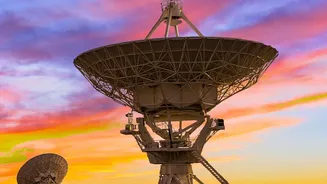
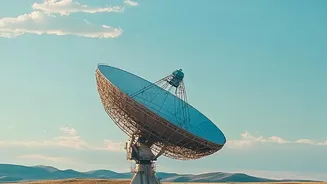
in the radio-quiet deserts of South Africa and Western Australia. The South African site, SKA-Mid, features an array of nearly 200 large dish antennas, while the Australian site, SKA-Low, will consist of over 131,000 smaller, Christmas-tree-like antennas. Linked by vast fibre optic networks and processed by some of the world's most powerful supercomputers, these arrays work together as a single, gigantic, and extraordinarily sensitive radio telescope. This dual-site approach allows the observatory to scan a wide range of radio frequencies, capturing different cosmic signals simultaneously.
Listening to the Cosmic Dawn
One of the SKA's primary missions is to peer back in time to an era known as the Cosmic Dawn. This period, which occurred hundreds of millions of years after the Big Bang, is when the very first stars and galaxies ignited, ending the cosmic 'dark ages'. Before this, the universe was filled with a fog of neutral hydrogen gas. The intense ultraviolet light from these first stars began to burn through this fog, creating bubbles of ionised gas in a process called the Epoch of Reionisation. The SKA-Low telescope in Australia is specifically designed to detect the faint radio signals emitted by this neutral hydrogen before it was reionised. By mapping these signals, scientists hope to create a 3D picture of the early universe, revealing how and when the first luminous objects formed and fundamentally changed the cosmos.
India's Crucial Role in the Cosmic Quest
India is a full member of the SKA project and has played a pivotal role from its early days. The National Centre for Radio Astrophysics (NCRA) in Pune coordinates India's significant contributions, which go far beyond financial investment. A key contribution has been leading the design and development of the Telescope Manager, the complex software system that will serve as the 'neural network' or 'brain' of the entire observatory. This system is responsible for controlling, monitoring, and running the telescopes to execute astronomical observations. Indian scientists and engineers are also heavily involved in developing digital signal processing hardware and data processing software. Furthermore, India is home to the Giant Metrewave Radio Telescope (GMRT), an important SKA 'pathfinder' facility that serves as a precursor and testbed for SKA technologies and science.
Beyond the First Stars
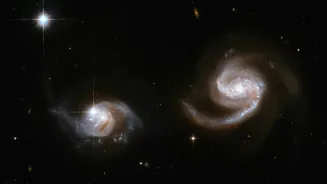
While uncovering the secrets of the early universe is a headline goal, the SKA's capabilities are vast. Its unprecedented sensitivity will allow it to tackle other fundamental mysteries in physics and astronomy. The observatory will conduct extreme tests of Einstein's theory of general relativity by studying pulsars—the incredibly dense, spinning remnants of stars—in extreme gravitational environments. It will also map the magnetic fields that thread through the cosmos, a force that is poorly understood but crucial to galaxy evolution. The SKA will create detailed surveys of a billion galaxies to shed light on the nature of dark matter and dark energy, the mysterious components that make up most of our universe. And while it's not its primary function, the SKA will be so sensitive that it could detect signals equivalent to an airport radar from dozens of light-years away, making it a powerful tool in the search for extraterrestrial intelligence (SETI).