



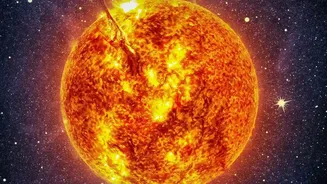
What Is Space Weather?
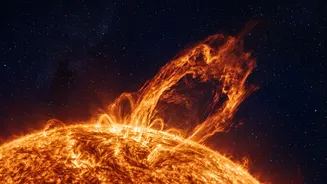
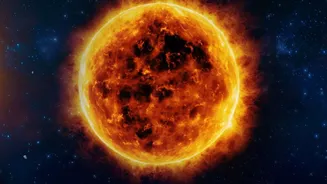
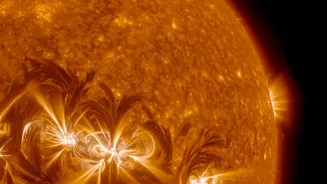
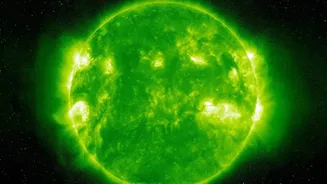
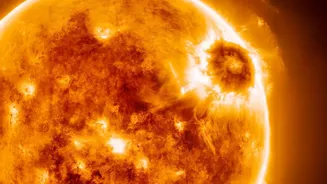
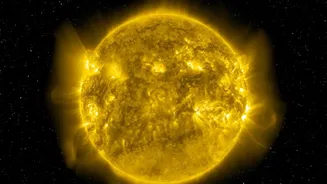
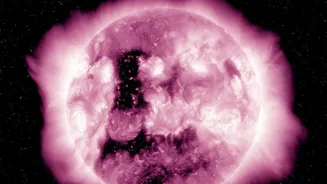
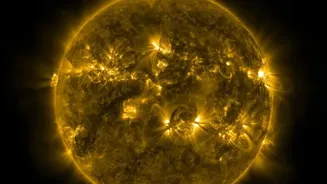
Space weather refers to the changing conditions in space driven by the Sun's activity. The main culprits are solar flares and coronal mass ejections (CMEs). Think of a CME as a colossal solar sneeze, blasting billions of tons of magnetised plasma into
space. If Earth is in the path of one of these events, it can interact with our planet's natural magnetic shield, triggering what’s known as a geomagnetic storm. While these storms are famous for creating beautiful auroras, they also carry a significant threat to the technological backbone of modern society. We are increasingly vulnerable as we approach the next 'solar maximum', a peak in the Sun's 11-year activity cycle expected around 2025, which increases the risk of powerful storms.
The High Stakes for Earth
A severe geomagnetic storm is more than just a light show. It can induce powerful electrical currents on the ground that can overload and damage power grids, leading to widespread and long-lasting blackouts. The most intense solar storm on record, the 1859 Carrington Event, set telegraph stations on fire. A similar event today would be catastrophic, crippling everything from global communications and GPS navigation to banking and healthcare systems that rely on that infrastructure. Even less extreme storms can damage satellites by frying their electronics or causing them to lose altitude and fall out of orbit, disrupting the services we rely on for internet, weather forecasting, and more.
Enter DAGGER: An AI Early Warning System
To counter this threat, an international team of researchers, in a partnership that includes NASA, has developed an AI model called DAGGER (Deep Learning Geomagnetic Perturbation). This system represents a major leap forward from previous forecasting methods, which were often either localized or not timely enough to be effective. DAGGER uses a form of AI called deep learning to analyse real-time data on the solar wind—the constant stream of particles from the Sun—collected by various spacecraft. By identifying complex patterns in this data, it can predict the location and intensity of a geomagnetic disturbance anywhere on Earth.
The Power of a 30-Minute Head Start
The crucial advantage of DAGGER is speed. It can generate a specific, global forecast with a 30-minute lead time. The model produces these predictions in less than a second and updates them every minute. While 30 minutes might not sound like much, it's a game-changer for infrastructure operators. This window gives power grid companies time to reroute power or take vulnerable transformers offline to prevent catastrophic failure. Satellite controllers can place their spacecraft into a protective safe mode, and airlines can reroute flights that would otherwise pass through polar regions where the effects are strongest. According to Vishal Upendran of the Inter-University Centre for Astronomy and Astrophysics in India, the lead author of the paper on the model, this AI makes it possible to minimise or even prevent devastation to modern society.
An Open-Source Shield for Everyone
One of the most significant aspects of the DAGGER project is that its computer code is open source. This means that power grid operators, telecommunications companies, and other relevant organisations around the world can adopt and adapt the model for their specific needs. This democratisation of space weather forecasting allows for a more coordinated and robust global defence against the Sun's fury. By providing a clear, actionable warning, the AI tool shifts our posture from being reactive victims of space weather to proactive defenders of our critical infrastructure. It is a vital tool for building resilience in a world that runs on technology.