





The Challenge: Earth's Most Precious Resource
Water is heavy. Launching just one gallon into orbit costs thousands of dollars, and a mission to Mars could take years. The sheer volume of water needed for drinking, food preparation, and hygiene for a crew over that time would be astronomically expensive
and take up valuable space on a spacecraft. Before advanced recycling, water made up nearly half the payload on resupply missions to the International Space Station (ISS). This staggering logistical problem is the primary driver behind one of NASA's most critical innovations: the closed-loop water system. The goal isn't just to save money; it's to make long-duration missions to the Moon, Mars, and beyond feasible at all.
The Solution: A Miniature Water Cycle
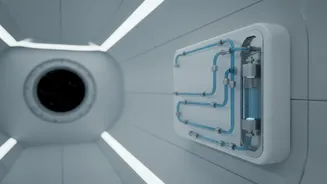
The system at the heart of this effort is the Environmental Control and Life Support System (ECLSS). Think of it as a miniature, mechanical version of Earth's own water cycle. It collects every drop of moisture it can: condensation from the cabin air (mostly from astronaut breath and sweat), and yes, urine. This collected wastewater, far more concentrated than what we're used to on Earth, is then sent on a journey to become potable again. The process is so effective that NASA has recently achieved a recovery rate of 98%, a crucial milestone for future deep-space exploration.
From Wastewater to Drinking Water
The process involves several key steps. Urine is sent to the Urine Processor Assembly (UPA), which uses a process called vacuum distillation. In microgravity, you can't simply boil water, so the UPA uses low pressure to evaporate the water from the urine, leaving behind a concentrated waste brine. The collected moisture from breath and sweat, along with the distilled water from the UPA, then goes to the Water Processor Assembly (WPA). Here, it passes through a series of specialized filters and a catalytic reactor that breaks down any remaining contaminants. Sensors constantly check the water's purity, and any batch that doesn't meet the stringent standards is sent back to be reprocessed. The final product is cleaner than most tap water on Earth.
Closing the Loop: The Brine Processor
For years, the recovery rate hovered around 93-94%, with the last few percent of water trapped in the salty urine brine from the UPA. To get closer to a truly closed loop, NASA developed the Brine Processor Assembly (BPA). This newer piece of hardware takes that leftover brine and runs it through a special membrane. Warm, dry air is blown over it, evaporating the last remnants of water. This humid air is then captured by the station's dehumidifiers and fed back into the system. It was the addition of the BPA that pushed the overall water recovery rate to the 98% target needed for a Mars mission.
Eliminating Payload, Enabling Exploration
The headline's claim of eliminating "payload waste" refers to this incredible reduction in the need to launch water from Earth. Every pound of water recycled is a pound of scientific equipment, food, or other critical supplies that can be launched instead. As Christopher Brown of NASA's Johnson Space Center explained, if you start with 100 pounds of water, you only lose two pounds, while the other 98 just keep cycling through the system. This level of regeneration is what transforms spaceflight from a series of short, expensive trips into the realm of sustainable, long-term exploration. For missions to the Moon or Mars, where resupply is impossible, these robust, reliable regenerative systems are not just helpful—they are essential.