





Hunting for Planetary Shadows
The first step in studying an exoplanet’s atmosphere is simply finding it and confirming it has one. The most common method is called the 'transit method'. Astronomers point powerful telescopes at a star and watch for a tiny, periodic dip in its brightness.
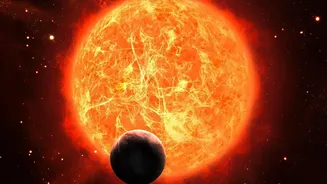
This dip is the star’s light being momentarily blocked by a planet passing in front of it—a planetary silhouette crossing its sun. If this planet has an atmosphere, a tiny fraction of the starlight will filter through it on its way to Earth. This sliver of light is the key, holding clues about the planet’s air, temperature, and weather.
Decoding a Planet’s Atmosphere
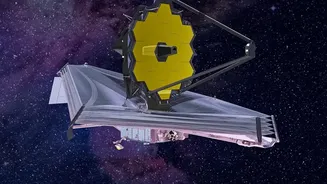
This is where a technique called spectroscopy comes in. Think of it as using a prism to break starlight into its full spectrum of colours, like a rainbow. When starlight passes through a planet's atmosphere, different chemical elements and molecules in that atmosphere absorb very specific colours, or wavelengths, of light. This leaves a unique pattern of dark lines in the star's spectrum—a sort of chemical barcode. By analysing which colours are missing, astronomers can identify the elements present, such as sodium, water vapour, or even vaporised metals. Instruments like the ESPRESSO spectrograph on the Very Large Telescope (VLT) are so precise they can read these barcodes from hundreds of light-years away.
Finding Iron in the Skies
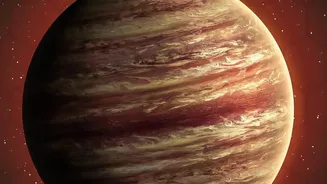
On ultra-hot exoplanets, like the famous WASP-76b, temperatures on the side permanently facing its star can soar above 2,400 degrees Celsius. This is hot enough to vaporise metals, including iron. As a result, the atmosphere on the planet's 'day side' becomes filled with iron vapour. When astronomers observed WASP-76b, they used high-resolution spectroscopy and detected the unmistakable signature of iron atoms in the light filtering through the atmosphere at the 'evening' edge of the planet—the line where day transitions to night. The presence of this metallic vapour was the first major clue to its extreme weather.
Clocking Supersonic Winds
Detecting iron is one thing, but how do you measure wind speed from so far away? Scientists use the Doppler effect, the same principle that makes an ambulance siren change pitch as it passes you. Light waves from a moving object also shift. If the object’s atmosphere is moving towards us, its light shifts to the blue end of the spectrum (blueshift); if it's moving away, it shifts to the red end (redshift). By measuring the Doppler shift in the spectral lines of the iron vapour, astronomers can calculate how fast the atmosphere is moving. For many 'hot Jupiters', this isn't a gentle breeze. The extreme temperature difference between the blistering day side and the cooler night side drives ferocious winds that can reach several kilometres per second—far faster than the speed of sound.
A Portrait of an Extreme World
Putting all these clues together for a planet like WASP-76b reveals a truly alien weather cycle. The planet is 'tidally locked', meaning one side always faces its star, much like how the same side of the Moon always faces Earth. On the permanent day side, iron is vaporised into the atmosphere. Supersonic winds then whip this iron vapour across to the cooler night side, where temperatures drop to around 1,500 degrees Celsius. At this lower temperature, the iron vapour condenses into liquid droplets. Astronomers confirmed this by noticing that the iron signature vanished on the 'morning' side of the planet. The iron had literally rained out of the atmosphere during the long night, falling deep into the gas giant's interior.