






A Tale of Two Sides
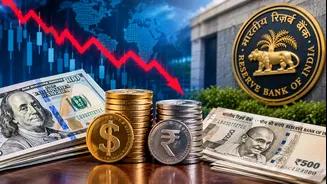
At its core, the exchange rate is the price of one currency in terms of another. When we say the rupee has 'weakened' or 'depreciated' against the US dollar, it means you need more rupees to buy one dollar. Conversely, a 'stronger' rupee means you need fewer.
This simple fluctuation is a double-edged sword for India's trade. For some businesses, a weaker rupee is a massive advantage, while for others, it's a significant burden. This dynamic is central to understanding India's trade balance—the difference between what it earns from exports and what it spends on imports.
The Exporter's Advantage
A weaker rupee is often good news for India's exporters. Imagine an Indian IT company that provides services to a US client for $1 million. If the exchange rate is ₹90 to a dollar, the company earns ₹9 crore. But if the rupee weakens to ₹95, the same $1 million contract now brings in ₹9.5 crore. This makes Indian goods and services—from software and pharmaceuticals to textiles and engineering goods—cheaper and more competitive on the global stage. This can lead to higher export volumes, increased profits for exporting companies, and a boost to domestic investment and job creation. Recent data shows strong growth in sectors like electronic goods, which benefit from this competitive pricing.
The Importer's Burden
On the flip side, a weaker rupee makes imports more expensive. India is heavily dependent on imports for crucial commodities, most notably crude oil, of which it imports nearly 85% of its needs. When the rupee falls, the cost of every barrel of oil goes up in rupee terms, even if the dollar price remains the same. This directly translates to higher prices for petrol and diesel. The same applies to imported electronics, machinery components, and certain chemicals. This 'imported inflation' can drive up the cost of living for everyone and squeeze the profit margins of industries that rely on foreign raw materials. The rising cost of imports is a primary reason for India's trade deficit, where the value of imports exceeds that of exports.
The RBI's Delicate Balancing Act
Given these conflicting effects, the Reserve Bank of India (RBI) plays a crucial role. Its official stance is not to target a specific exchange rate but to manage volatility. The central bank intervenes in the currency market to prevent extreme and sudden swings that could destabilise the economy. If the rupee depreciates too quickly, the RBI may sell dollars from its foreign exchange reserves to increase the supply of dollars and support the rupee. Conversely, if the rupee appreciates too rapidly, it might buy dollars to prevent exports from becoming uncompetitive. Recent measures announced in October 2026, such as creating a special window for oil companies to source dollars and tightening rules on currency derivatives, are examples of the RBI's efforts to curb speculation and maintain order.
What It Means for the Economy
The rupee's exchange rate is a key indicator of the economy's health. After facing depreciation pressures that saw it near ₹97 to the dollar, the rupee has recently seen a recovery following the RBI's interventions, strengthening to around the ₹95 mark as of mid-October 2026. A stable currency inspires confidence among foreign investors, whose capital flows are vital for growth. However, the balance is delicate. While a weaker rupee aids exports, it can widen the current account deficit if the import bill grows faster. It also makes foreign education and travel more expensive for Indians and increases the repayment burden for companies with dollar-denominated loans. Ultimately, the exchange rate reflects a complex interplay of trade flows, capital movements, inflation, interest rates, and global economic conditions.