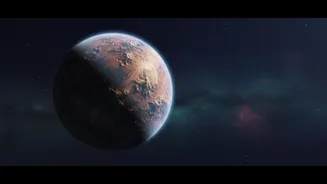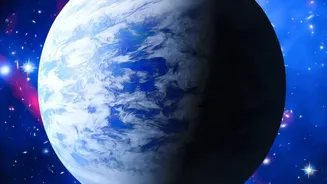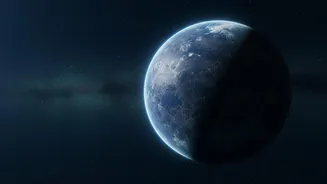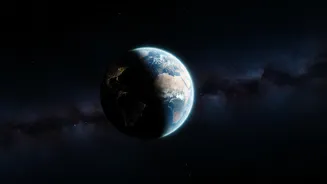




A Glimpse into Distant Skies
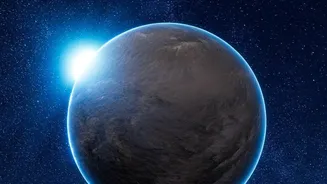
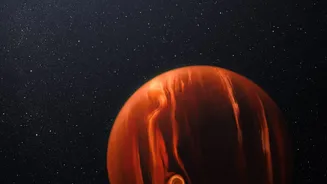
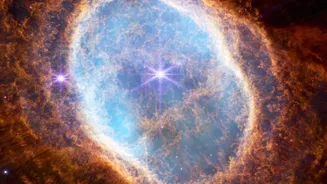
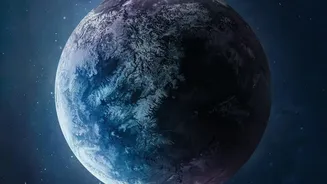
The latest breakthroughs from the JWST have provided some of the most detailed atmospheric analyses of exoplanets to date. An exoplanet is simply a planet that orbits a star outside our solar system. Scientists have used the telescope's powerful instruments
to study starlight filtering through the atmospheres of these distant worlds. Recent announcements highlight the detection of water vapour, and sometimes other molecules like carbon dioxide, on several planets. One such world, located about 48 light-years away, shows unambiguous signs of atmospheric moisture, a landmark discovery for a temperate, rocky planet. While over 5,000 exoplanets have been confirmed since the 1990s, the ability to peer into their atmospheres with such clarity is a recent development, marking a new chapter in astronomy.
How Webb Makes These Discoveries
The technology behind these findings is a method called transmission spectroscopy. When an exoplanet passes in front of its host star from our perspective—an event called a 'transit'—a tiny fraction of the starlight shines through the planet's atmosphere. The JWST's highly sensitive Near-Infrared Spectrograph (NIRSpec) and other instruments capture this light and break it down into a spectrum, which is like a rainbow of colours. Different gas molecules in the atmosphere absorb specific colours, or wavelengths, of light, leaving behind a unique barcode-like pattern of dark lines. By analysing this pattern, astronomers can identify precisely which gases are present, including the distinct signature of water. This technique is so powerful that it allows scientists to understand the chemical makeup of worlds that are trillions of kilometres away.
Why Water Vapour Is a Big Deal
On Earth, life as we know it is fundamentally dependent on water. Finding its ingredients on other worlds is a critical step in assessing their potential for habitability. Detecting water vapour confirms that one of the most essential building blocks for life exists beyond our solar system. It suggests that the processes that delivered water to Earth might be common throughout the galaxy. However, the presence of water vapour is just one piece of the puzzle. The discovery expands the range of planets that scientists can prioritise for further study, helping them narrow down the search for worlds that might have the right conditions for liquid water to exist on their surface. In some cases, like with the exoplanet LHS 1140 b, signs of an atmosphere and a protective 'cold trap' suggest the world could have retained an ocean, making it a prime candidate for future observation.
Managing Cosmic Expectations
It's important to be clear: detecting water vapour in an atmosphere is not the same as finding flowing rivers or deep oceans, and it certainly isn't proof of alien life. Many of the planets where water has been found are inhospitable 'gas giants' or scorching hot 'steam worlds' with surface temperatures of hundreds of degrees Celsius. For example, the planet GJ 9827 d, while rich in water vapour, is thought to be a 'steam world' that is not suitable for life as we know it. These discoveries are exciting because they prove the telescope's capability. They are a technological stepping stone, demonstrating that if an Earth-like planet with a water-rich atmosphere is out there, the JWST has the tools to find it. These findings help refine models of planet formation and guide the search for true Earth analogues.
The Search Continues
The James Webb Space Telescope is still early in its mission, and its impact on exoplanet science is just beginning. Each new detection of an atmospheric component adds another layer to our understanding of the diversity of planets in our galaxy. Astronomers now plan to use the telescope to hunt for potential biosignatures—gases that could be produced by living organisms—in the atmospheres of the most promising candidates. Follow-up observations will focus on rocky planets within their stars' 'habitable zones,' the orbital region where temperatures could allow liquid water to pool on the surface. The ultimate goal is to find a world with a chemical imbalance in its atmosphere, which could be a tantalising hint that some biological process is at work.