


Why Humidity Drains Your Energy
Before diving into the solution, it helps to understand the problem. When you exercise, your body sweats to cool down. As the sweat evaporates from your skin, it takes heat with it. However, in high humidity, the air is already saturated with water vapour,
making it much harder for your sweat to evaporate. Your body's primary cooling mechanism becomes inefficient. As a result, your core temperature can rise, your heart has to work harder to pump blood to your skin to try and cool you down, and your body expends significant energy just trying to maintain a safe internal temperature. This entire process leads to that profound feeling of sluggishness, fatigue, and even heat exhaustion if you aren't careful.
The Power of Water Workouts
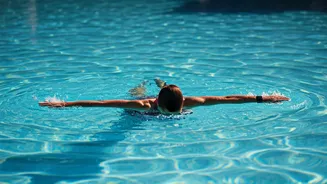
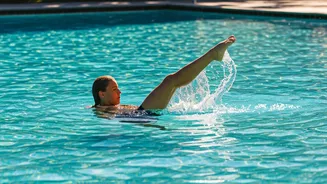
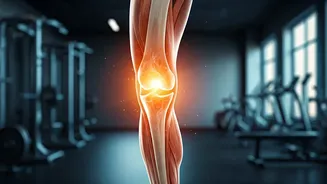
This is where exercising in water, or aqua calisthenics, becomes a game-changer. Water offers three key advantages that directly counter the effects of humidity. First, it provides a constant cooling effect, pulling excess heat away from your body far more effectively than air can. Second, the natural buoyancy of water supports up to 90% of your body weight. This dramatically reduces impact on your joints, making it an ideal environment for people of all fitness levels, including those with joint pain or injuries. Finally, the water provides gentle, consistent resistance from all directions, forcing your muscles to work in a balanced way without the need for weights.
1. Water Walking and Jogging
The simplest way to start. Begin by walking from one end of the pool to the other in waist-deep water. Focus on maintaining good posture—stand tall, keep your core engaged, and swing your arms as you would on land. The water's resistance will make this surprisingly challenging. Once you feel comfortable, you can progress to jogging in place or across the pool. This is a fantastic full-body warm-up that gets your heart rate up without any harsh impact on your knees or ankles.
2. High Knees
Standing in waist-to-chest-deep water, bring one knee up towards your chest, then lower it and repeat with the other leg. You can do this in place or while moving forward. The goal is to move with control, using the water's resistance to work your core and leg muscles. This exercise is excellent for improving balance and strengthening your hip flexors and lower abdominal muscles. Aim for 30-60 seconds per set.
3. Leg Kicks (Forward and Sideways)
For forward kicks, hold onto the side of the pool for support. Keeping your leg straight, kick forward as high as is comfortable, then slowly lower it back down against the water's resistance. For side kicks, turn and face the pool wall, holding on with both hands. Kick one leg out to the side, keeping your torso stable. These movements are brilliant for toning your quadriceps, hamstrings, and glutes. The controlled motion is key to maximising the resistance training.
4. Water Jumping Jacks
A low-impact version of a classic cardio move. Standing in chest-deep water, start with your feet together and arms at your sides. Jump your feet out to the sides while simultaneously raising your arms out to the water’s surface. Jump back to the starting position. The water slows the movement down and eliminates the jarring impact, making it a safe yet effective way to elevate your heart rate and work your entire body.
5. Arm Curls and Presses
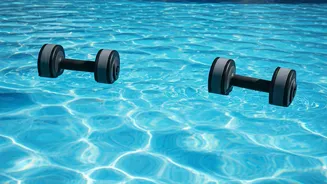
You don't need dumbbells when you have water. For curls, stand with your arms at your sides, palms facing forward. Bend your elbows and curl your hands up towards your shoulders, keeping your palms open to catch the water. For presses, start with your hands at your shoulders, palms facing down. Push your hands down towards your thighs. In both movements, the water provides resistance in both directions, working opposing muscle groups (biceps and triceps) with a single exercise.