



An Ocean World Far From the Sun
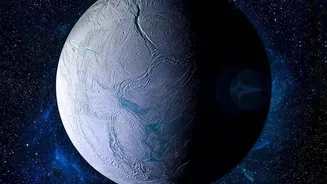
At first glance, Europa seems inhospitable. Its surface is a solid sheet of ice, with temperatures colder than any place on Earth. Yet, for decades, scientists have gathered strong evidence that beneath this frozen crust lies a vast, global ocean of liquid
saltwater. This ocean is estimated to contain more than twice the volume of all of Earth's oceans combined. The secret to this hidden warmth isn't sunlight, but gravity. Jupiter's immense gravitational pull constantly squeezes and stretches the moon, creating tidal forces that generate heat from within. This internal energy is enough to keep the water from freezing solid, creating a potentially habitable environment shielded from the harsh radiation lashing its surface.
Meet the Clipper: Our Robotic Explorer
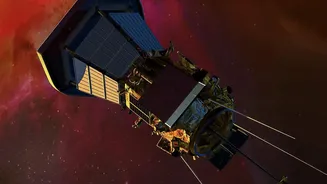
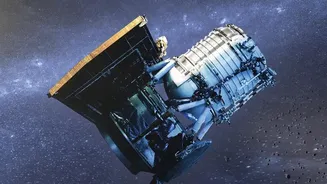
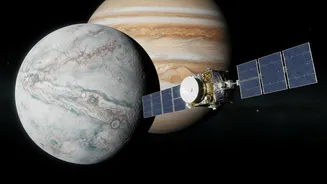
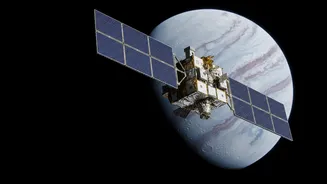
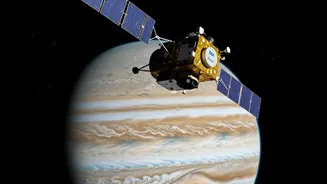
To investigate this tantalising world, NASA has dispatched the Europa Clipper, the largest interplanetary spacecraft the agency has ever built. Launched in October 2024, this sophisticated robot is currently on a long and complex journey to the Jupiter system, scheduled to arrive in April 2030. Its journey involves clever gravity-assist manoeuvres, using Mars's gravity in 2025 and Earth's in December 2026 to slingshot itself towards the outer solar system. Upon arrival, the Clipper won’t orbit Europa directly, as Jupiter's intense radiation field would quickly fry its electronics. Instead, it will enter a long, looping orbit around Jupiter and perform nearly 50 close flybys of Europa, dipping in to gather data before retreating to safety. This strategy will allow the mission to study the moon for years.
The Search for Life's Ingredients
Europa Clipper is not designed to find life directly. Instead, its primary goal is to determine if Europa has the necessary ingredients for life as we know it: liquid water, essential chemical elements, and an energy source. The spacecraft is equipped with a powerful suite of nine science instruments to achieve this. An ice-penetrating radar will measure the thickness of the ice shell, which could be anywhere from a few kilometres to over 30 kilometres deep, and search for pockets of water within it. Spectrometers will analyse the chemical composition of the surface, looking for salts and organic molecules that may have bubbled up from the ocean below. Other instruments will measure Europa's magnetic field to confirm the ocean's existence and even estimate its depth and saltiness. The mission will also search for plumes of water vapour that may be venting into space from cracks in the ice, offering a chance to directly sample the ocean's contents without having to drill through the shell.
Why This Mission Matters
The implications of what Europa Clipper might find are profound. On Earth, life thrives in the deepest, darkest parts of the ocean around hydrothermal vents, which provide heat and chemical energy. Scientists believe similar vents could exist on Europa's seafloor, potentially supporting a whole ecosystem independent of sunlight. Discovering that Europa is habitable would fundamentally change our understanding of life in the universe. It would suggest that life isn’t a rare fluke confined to planets like Earth, but could be common in the hidden oceans of icy moons throughout our solar system and beyond. While the main science phase won't begin until its arrival in 2030, the mission is already a monumental feat of engineering and a testament to human curiosity.