




The Mystery of the Little Red Dots
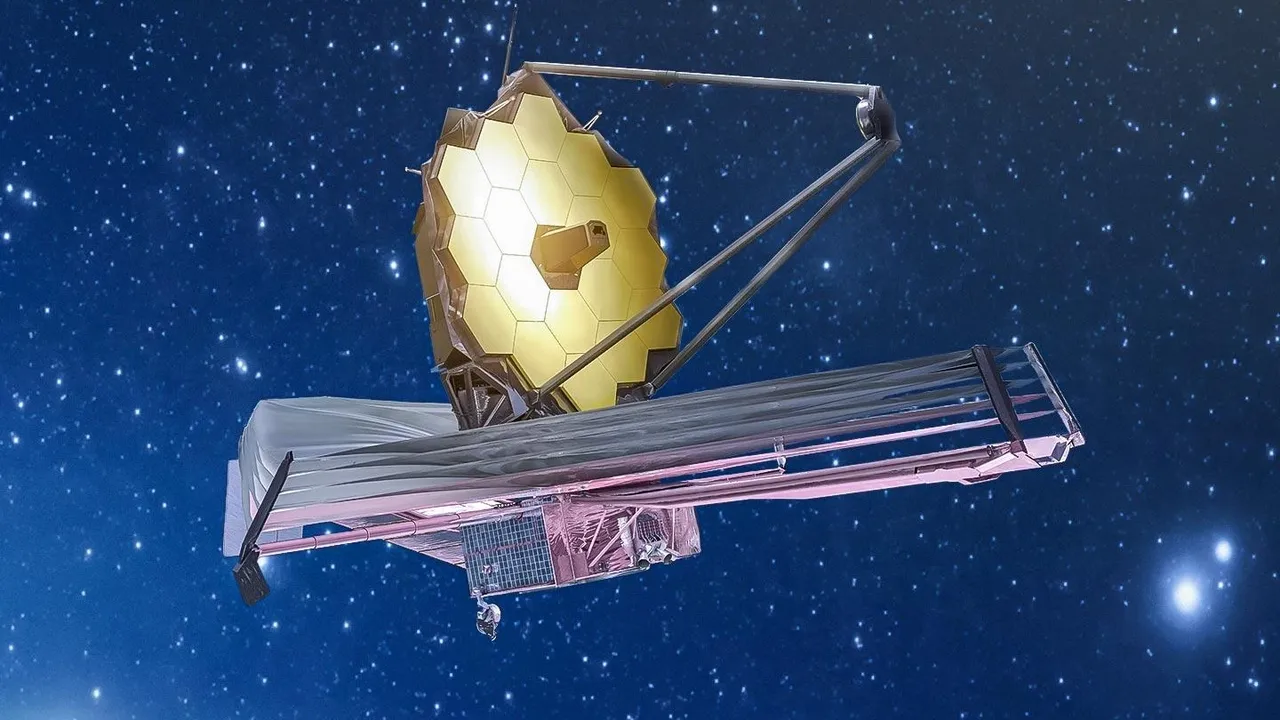
Since it began operations, the JWST has been revolutionising our view of the early universe. Among its most puzzling discoveries is a population of objects descriptively named 'little red dots' (LRDs). These are extremely distant, compact sources of light
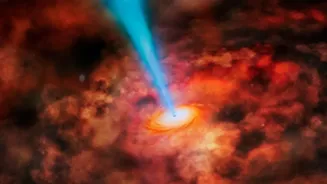
that appear deep red in Webb's infrared vision. Their colour and distance tell us we are seeing them as they were in the cosmic dawn, just a few hundred million years after the Big Bang. The initial excitement surrounding LRDs was immense because they seemed to be the solution to a long-standing cosmological headache: how did supermassive black holes get so big, so fast? The leading theory was that each red dot was an active galactic nucleus (AGN)—a nascent, rapidly growing supermassive black hole devouring gas and dust at the heart of a primordial galaxy.
Seeds of Colossal Black Holes?
If LRDs were indeed young AGNs, they would represent the 'seeds' of the colossal black holes we see in the centre of nearly every large galaxy today, including our own Milky Way. Finding them would fill a critical gap in our understanding of cosmic evolution. Evidence seemed to support this: many of these dots showed signs of gas swirling at incredible speeds, a strong indicator of a black hole's immense gravitational pull. For a time, it seemed the mystery was solved. Astronomers believed they were finally witnessing the obscured, adolescent phase of black hole growth that theories had predicted for decades. The red colour was attributed to the thick veil of dust surrounding the furiously feeding black hole, which absorbs bluer light and lets only the redder light escape across billions of light-years to reach Webb's mirror.
A Dot That Doesn't Fit
But science thrives on anomalies, and a new, detailed study of one of these red points has thrown a wrench in this tidy narrative. As astronomers used Webb's powerful spectrographs to dissect the light from individual LRDs, they found that not all of them looked like classic AGNs. While the prevailing theory holds that LRDs are powered by black holes, some of these objects lack key signatures, such as the expected X-ray emissions. One dot in particular, an object nicknamed 'The Cliff' by astronomers for its dramatic spectral features, stands out as a clear exception. Another dot, GLIMPSE-17775, has provided the deepest spectrum reading to date. Instead of the clear profile of a quasar, its light signature is more consistent with a different, though equally extreme, phenomenon. This has forced scientists to consider alternative explanations that were once on the fringes.
An Exotic New Object?
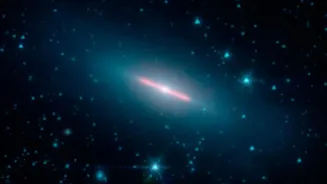
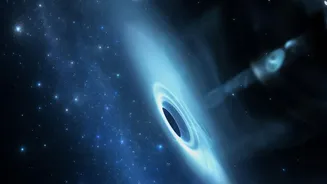
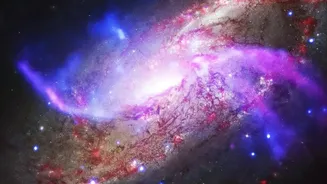
The scrutiny of these outlier dots has revived several exotic theories. One compelling idea is that some LRDs are not traditional AGNs but something even stranger: a 'black hole star' or 'quasi-star'. This theoretical object consists of a black hole at its core, but one that is enveloped in a massive, dense cocoon of gas that shines like a star. This model could explain both the intense brightness and the lack of certain AGN characteristics. Another possibility is that some LRDs are not powered by black holes at all, but are incredibly dense, dust-obscured starburst galaxies, where stars are forming at a rate almost impossible to imagine. Recent research has also suggested that what we see as a 'dot' might just be the tip of the iceberg—the ultrabright nucleus of a much larger host galaxy that is simply too faint for even Webb to detect at such extreme distances. A study of a closer galaxy nicknamed 'Saguaro' showed that if it were observed in the early universe, only its bright red nucleus would be visible, making it look exactly like an LRD.
A More Complicated Universe
This fresh scrutiny doesn't necessarily mean the original theory is wrong. It's more likely that the term 'little red dot' is an umbrella category for several different types of objects that happen to look similar from 13 billion light-years away. Some may be the long-sought baby black holes, others might be these exotic quasi-stars, and still others could be compact galaxies. The challenge—and the excitement—for astronomers now is to untangle this cosmic identity parade. Each dot is a puzzle piece from the universe's infancy. Figuring out what they are, and what they become, will rewrite our understanding of how the first stars, galaxies, and black holes came into being. The simple red dot has become a symbol of a more complex and fascinating early universe than anyone anticipated.