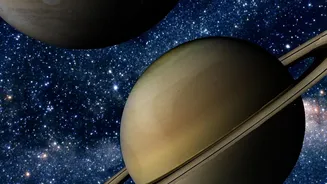







Jupiter’s Grand Autumn Return
While Jupiter was at its absolute brightest for the year back in January, this autumn marks its grand reappearance in the pre-dawn hours. Having been hidden by the Sun's glare during the summer, the gas giant is now rising in the east a few hours before
sunrise, climbing higher and becoming easier to spot each week. To the naked eye, it will appear as a strikingly bright, steady, yellowish-white light that doesn't twinkle like a star. Autumn 2026 also offers several special occasions for Jupiter-watchers. The planet will have close approaches with the Moon in early September, October, and November, creating beautiful pairings in the morning sky. In mid-November, Mars will join Jupiter, offering a chance to see two planets appearing close together. These events make it a particularly rewarding season for new astronomers to begin their journey.
Your Pocket Planetarium
The single most powerful tool for any aspiring stargazer is already in your pocket. Modern smartphone applications have transformed astronomy from an intimidating science into an accessible hobby. These apps use your phone’s built-in GPS and compass to know exactly where you are and which way you’re pointing. They then overlay a map of the stars, planets, and constellations onto your screen, creating a kind of augmented reality window into the cosmos. Simply point your phone at the sky, and the app will identify what you're looking at. For a beginner, this technology removes the biggest barrier: the overwhelming feeling of not knowing where to even start looking.
Top Apps for Aspiring Astronomers
With dozens of apps available, choosing one can be daunting. For beginners, the best options are typically free and focus on ease of use. Star Walk 2 is a popular choice, celebrated for its beautiful graphics and intuitive interface that makes identifying celestial objects feel like a game. Another excellent option is SkyView Lite, which uses your camera to create a seamless augmented reality experience, letting you spot planets and constellations day or night. For those who want a bit more scientific depth without a steep learning curve, Stellarium Mobile offers a free version that provides a realistic and highly accurate sky map. All of these are available for both iOS and Android and are more than capable of guiding you straight to Jupiter.
A Step-by-Step Guide to Finding Jupiter
Once you have an app installed, finding the largest planet in our solar system takes only a minute. First, find a location with a clear view of the eastern horizon, preferably away from bright city lights. Give your eyes about 15 minutes to adjust to the darkness. Open your chosen stargazing app and give it a moment to calibrate to your location. Most apps have a search function; simply type in "Jupiter" and select it. An arrow or other indicator will appear on your screen. All you have to do is move your phone in the direction of the arrow until the on-screen Jupiter aligns with the real one in the sky. It will be the brightest point of light in that patch of sky.
What to Look For Beyond the Bright Dot
Locating Jupiter with your phone is just the beginning. The real magic happens when you know what you’re seeing. While it appears as a bright dot to the naked eye, a simple pair of binoculars can reveal a breathtaking secret. By bracing your binoculars against a steady surface to prevent shaking, you can often spot up to four tiny pinpricks of light flanking the planet in a neat line. These are not stars, but Jupiter's four largest moons—Io, Europa, Ganymede, and Callisto—discovered by Galileo Galilei over 400 years ago. Observing them from your own backyard, knowing they are changing their positions every night, connects you directly to the grand, dynamic nature of our solar system.