






What is the Crew Escape System?
Think of the Crew Escape System (CES) as the ultimate ejection seat for a spacecraft. It is a powerful, quick-acting rocket system mounted at the very top of the main launch vehicle. Its sole purpose is to save the astronauts' lives in the event of a catastrophic
failure on the launchpad or during the initial ascent through the atmosphere. If the main rocket malfunctions, the CES is designed to fire its own powerful motors, pulling the crew module—the capsule carrying the astronauts—away from the danger in a matter of seconds. This system has to be faster and more powerful than the launch vehicle itself to create a safe distance. For the Gaganyaan mission, crew safety is the absolute highest priority, making the CES one of the most critical components of the entire program.
A Fiery Trial at High Altitude
While ISRO has previously tested the escape system from the launch pad, this recent test simulated a much more challenging scenario: an emergency at high altitude while the rocket is travelling at supersonic speeds. This is one of the most critical phases of any launch, where the vehicle is under immense aerodynamic stress. The test involved launching a dedicated Test Vehicle to a predetermined altitude. At that point, a failure was deliberately simulated, triggering the Crew Escape System. The powerful escape motors ignited, pulling the crew module away from the test rocket. Following the successful separation, the crew module deployed its complex parachute system to slow its descent before a simulated splashdown. This successful validation proves the system can function flawlessly under the extreme conditions of a real flight emergency.
A Symphony of Complex Engineering
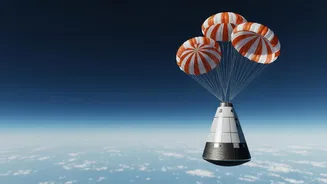
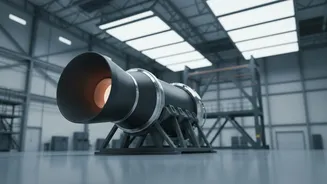
The success of the test is a testament to incredible engineering precision. The CES uses a series of five specially designed solid-fuel motors that burn their propellant at an extremely high rate to generate massive, immediate thrust. In a real emergency, this system could subject the crew to accelerations up to 10 times that of gravity. Once the crew module is safely clear of the rocket, another complex sequence begins: the deployment of parachutes. The Gaganyaan module uses a total of 10 parachutes to manage its descent. Initially, smaller drogue parachutes deploy to stabilize the capsule. These are followed by a set of three massive main parachutes, which slow the nearly 5-tonne module to a safe speed for its final splashdown in the ocean. Redundancy is built in, with just two of the three main parachutes being sufficient for a safe landing.
Building on a Foundation of Tests
This high-altitude abort test is the latest in a comprehensive series of trials designed to validate every aspect of the Gaganyaan mission's safety protocols. Over the past few years, ISRO has conducted numerous crucial tests. These include Pad Abort Tests to verify escape from the launch pad, and multiple Integrated Air Drop Tests (IADT) where a full-scale dummy crew module was dropped from an aircraft to qualify the parachute system under various failure scenarios. The successful TV-D1 mission had already validated the crew escape system's performance in flight. Each test builds upon the last, systematically retiring risks and building confidence in the hardware that will one day carry Indian astronauts.
The Road Ahead for Gaganyaan
With the successful completion of this high-altitude abort test, ISRO has cleared a major hurdle on the path to its first crewed mission. Development of all major hardware, including the human-rated LVM3 rocket (HLVM3), the crew and service modules, and the life support systems, has reached an advanced stage. The next steps will involve further uncrewed test flights of the full Gaganyaan system. These missions will test the vehicle's performance in orbit and during re-entry, paving the way for the historic flight that will carry Indian astronauts into space. This recent success demonstrates that the programme is progressing steadily, with every component rigorously tested to ensure the safety of the 'Gaganauts'.