




A Drone for a Distant World
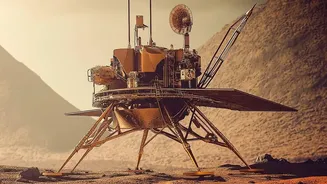
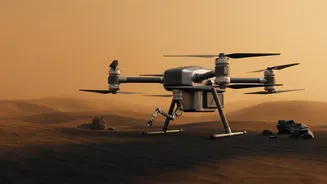
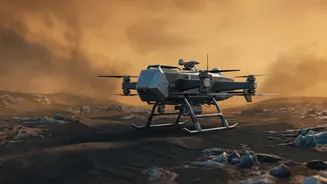
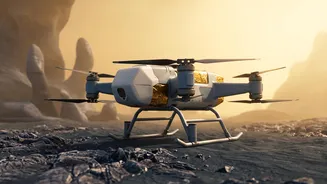
In July 2028, NASA plans to launch the Dragonfly mission, a nuclear-powered, eight-rotor drone destined for Titan. Unlike rovers that crawl across a surface, Dragonfly will be the first vehicle to perform powered, controlled flight on another moon. It's
a game-changing approach to planetary exploration. Arriving in 2034, Dragonfly will leverage Titan’s unique environment; its thick nitrogen atmosphere and low gravity make it more efficient to fly than to drive. This mobility is key, allowing the craft to leapfrog across miles of alien terrain, from organic sand dunes to the floor of an ancient impact crater, sampling diverse geology in a way no stationary lander ever could.
Titan: A Familiar Yet Alien Planet
So, why Titan? Of all the destinations in our solar system, Titan is unnervingly Earth-like. It's the only moon with a dense atmosphere and the only other body besides Earth with stable liquid on its surface. But there’s a twist. Titan’s 'water' cycle is based on methane. Methane clouds rain liquid methane, which carves rivers and pools into vast lakes and seas. The bedrock is water ice as hard as stone, and the dunes are made not of sand, but of solid organic particles. This bizarre, cold reflection of Earth—operating at a frigid -179 degrees Celsius—makes it a prime target for astrobiology. It contains all the key ingredients necessary for life: complex organic chemistry, an energy source, and the potential for liquid water beneath its crust.
Hunting for the Building Blocks of Life
The central mystery Dragonfly seeks to solve is about prebiotic chemistry—the steps that turn non-living chemicals into the building blocks of life. Titan is a planetary-scale chemical reactor. Its atmosphere, a mix of nitrogen and methane, is zapped by sunlight and radiation from Saturn, creating a thick smog of complex organic compounds that rain down onto the surface. These are the very kinds of molecules thought to have existed on a young Earth before life emerged. Dragonfly is equipped with a drill and a mass spectrometer (DraMS) to scoop up these materials and analyze them. Scientists want to see how far this chemistry has progressed and whether these organics have ever mixed with liquid water, perhaps from an impact melt or cryovolcanic flow, which could kickstart the creation of amino acids, a crucial precursor to life.
Is Titan Habitable?
Dragonfly's mission is to investigate Titan's habitability, both past and present. While the surface is too cold for life as we know it, scientists are interested in two main possibilities. The first is in places like the Selk Crater, the mission's initial landing area. An asteroid impact here billions of years ago would have melted the water-ice crust, creating a temporary pool of liquid water that mixed with the surface organics. Dragonfly will drill here to see what chemical reactions unfolded. The second possibility is the existence of a vast liquid water ocean deep beneath Titan's icy shell. The mission will use a seismometer to listen for 'Titanquakes,' which could help confirm the ocean's presence and reveal details about the moon's internal structure.
A Weather Report from Another World
Beyond the search for life’s origins, Dragonfly will act as a mobile weather station. Its suite of sensors, DraGMet (Dragonfly Geophysics and Meteorology), will measure temperature, pressure, wind, and other atmospheric conditions. By flying from place to place, it will provide a dynamic picture of Titan's methane cycle, which mirrors Earth's water cycle in surprising ways. These measurements will help scientists understand how the atmosphere interacts with the surface and could offer insights into the climate of early Earth, whose ancient atmosphere may have been similar to Titan’s today. The mission will essentially create the first multi-point weather reports from the surface of an outer solar system moon.