





The Target: An Icy World of Intrigue
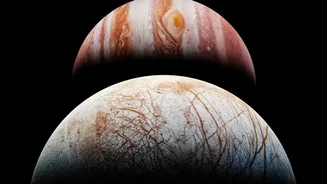
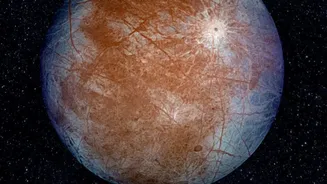
Europa, slightly smaller than Earth's own moon, is one of the most compelling destinations in our solar system. Discovered by Galileo Galilei in 1610, it appears as a bright, smooth sphere, crisscrossed with reddish-brown cracks. Scientists believe this
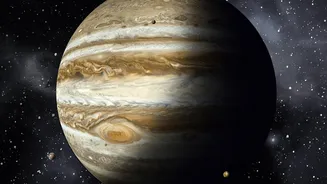
icy shell, estimated to be several kilometres thick, conceals a global ocean of liquid saltwater that may contain more than twice the volume of all of Earth's oceans combined. What keeps this distant ocean from freezing solid is a process called tidal heating. As Europa orbits the colossal planet Jupiter, the gas giant's immense gravity constantly squeezes and stretches the moon, generating enough internal friction and heat to maintain a liquid ocean. This makes Europa a prime candidate in the search for habitable environments beyond Earth.
The Mission: A Long Road to Jupiter
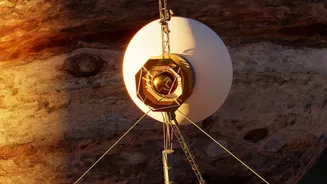
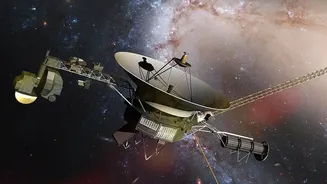
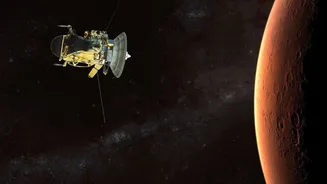
While the headline suggests the probe is actively using its radar now, the Europa Clipper is currently in the cruise phase of its epic journey. Launched on October 14, 2024, the spacecraft is undertaking a 2.9-billion-kilometre trek to the Jupiter system. To get there, it’s using a clever, fuel-saving trajectory that involves gravity assists. It already flew past Mars in March 2025 and is currently on a path that will bring it back for a flyby of Earth in December 2026. These planetary encounters act like cosmic slingshots, boosting the probe's speed. The spacecraft, the largest NASA has ever built for an interplanetary mission, is scheduled to arrive and enter orbit around Jupiter in April 2030. From there, it will begin its primary science mission, performing dozens of close flybys of Europa over four years.
The Tool: Peering Through Miles of Ice
To look for this hidden ocean, Europa Clipper is equipped with a suite of nine advanced science instruments. The star of the show is an ice-penetrating radar instrument named REASON, short for Radar for Europa Assessment and Sounding: Ocean to Near-surface. Developed in partnership with university scientists, REASON is designed to function like a geological ultrasound. It will transmit radio waves at two different frequencies that can penetrate deep into the ice shell, potentially as far as 30 kilometres. These signals will bounce off any boundaries they encounter below—such as the bottom of the ice shell, pockets of trapped water, or the theorized ocean itself. By analyzing the returning echoes, scientists can map the ice's thickness, uncover its internal structure, and, most importantly, confirm the existence and depth of the ocean.
The Goal: A Search for Habitability
It's important to clarify that Europa Clipper is not a life-detection mission; its instruments cannot directly find living organisms. Instead, its primary objective is to determine if Europa has all the necessary ingredients for life as we know it: liquid water, essential chemical elements, and a source of energy. REASON will tackle the water question directly. Other instruments will analyze the composition of materials on the surface, which may have seeped up from the ocean below, to understand the moon's chemistry. Scientists also suspect that Jupiter's intense radiation bombarding the surface could create energy-rich compounds that might find their way into the ocean, providing a potential energy source for life in the absence of sunlight. By studying these three key factors, Clipper will assess Europa's habitability and help scientists understand its potential to support life.