






What Exactly Is the Pink Planet?
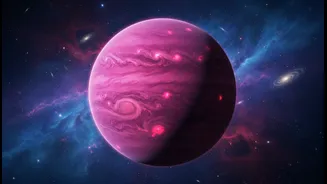
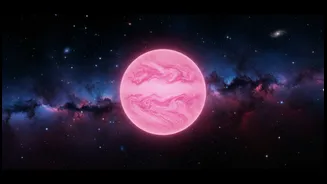
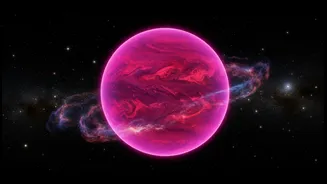
First discovered in 2013, GJ 504 b is a celestial object located about 57 light-years from Earth, orbiting a Sun-like star. It was nicknamed the 'Pink Planet' because of the striking magenta colour it displayed in early infrared images. For over a decade,
scientists have debated its very nature. With a mass estimated to be about 25 times that of Jupiter, it sits in a grey area, blurring the line between a giant planet and a brown dwarf (a type of 'failed star'). Because of this ambiguity, astronomers often refer to it as a 'planetary-mass companion' while they continue to investigate its origins.
So, Why Is It Pink?
The planet's colour isn't due to some vast, rosy-coloured surface. Instead, the magenta glow is a result of its residual heat. Like other giant gas worlds, GJ 504 b was incredibly hot after its formation and has been cooling down ever since. Its 'cool' temperature of around 290 degrees Celsius might sound scorching, but for a massive exoplanet, it's remarkably low. This heat makes the planet glow faintly, especially in the infrared spectrum of light, which is invisible to the human eye. The 'pink' appearance is an interpretation of this infrared data; if you could see it with your own eyes, it would likely not glow in visible light at all.
A Planet That Shouldn't Exist?
One of the biggest puzzles about GJ 504 b is its location. It orbits its star at a distance roughly 44 times farther than the Earth orbits the Sun. This poses a major challenge to the most widely accepted theory of planet formation, known as core accretion. This model suggests that planets form from a disk of gas and dust surrounding a young star, but it struggles to explain how such a massive planet could have formed so far out, where the raw materials should have been too sparse. Its existence suggests that our understanding of how giant planets are born might be incomplete.
New Clues from the James Webb Telescope
For years, GJ 504 b was too faint to study in detail with ground-based telescopes. But recent observations using the powerful James Webb Space Telescope (JWST) have peeled back a new layer of mystery. In 2026, researchers announced that in just two hours, the Webb telescope had successfully captured the planet's atmospheric fingerprint. The data revealed a complex atmosphere containing water vapor, methane, carbon dioxide, and ammonia. Most surprisingly, the data only made sense when models included the presence of clouds made of salt, providing the first strong evidence for a long-theorised type of exotic cloud on a cool, distant world.
What It Teaches Us
GJ 504 b is more than just a cosmic curiosity. It's a natural laboratory that pushes the boundaries of planetary science. The ongoing debate over whether it's a true planet or a brown dwarf forces scientists to refine the very definitions of these celestial bodies. Its improbable orbit challenges and expands theories of planetary formation, hinting at processes we have yet to discover. And the recent discovery of its salty clouds, made possible by the JWST, opens a new window into the atmospheric chemistry of cold, giant worlds. Each new discovery about the Pink Planet helps us piece together the grand, complex puzzle of how planetary systems across the galaxy come to be.