


The Search for Habitable Worlds
In the vast expanse of the cosmos, the search for extraterrestrial life often begins with a search for a single, simple molecule: water. On Earth, liquid water is the one non-negotiable ingredient for every form of life we know. It acts as a universal
solvent, transporting nutrients and facilitating the chemical reactions that make life possible. Because of this, astronomers hunting for potentially habitable planets focus on finding worlds that might host liquid water. These planets exist in the “habitable zone,” an orbital ring around a star where temperatures are just right—not too hot and not too cold—for water to exist on a planet's surface. But identifying a planet in this zone is just the first step. The real challenge is proving that water is actually there.
The Dazzling Problem of Starlight
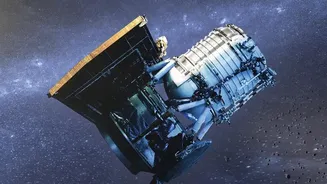
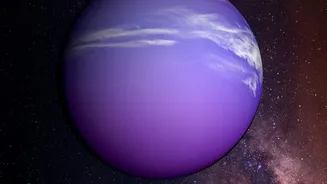
Studying the atmosphere of an exoplanet—a planet outside our solar system—is incredibly difficult. These planets are trillions of kilometres away and are infinitesimally faint compared to the blazing stars they orbit. Imagine trying to spot a firefly hovering next to a giant searchlight from kilometres away; the glare is overwhelming. This is the fundamental problem astronomers face. Previous telescopes, like the Hubble Space Telescope, have made amazing discoveries in visible light, but they often struggle to parse the tiny signal of a planet's atmosphere from its star's overpowering brightness. Furthermore, hazy clouds in a sub-Neptune planet's atmosphere can obscure the view, leading to frustratingly featureless readings that tell scientists very little. This is where seeing in infrared light becomes a superpower.
Webb’s Infrared Superpower
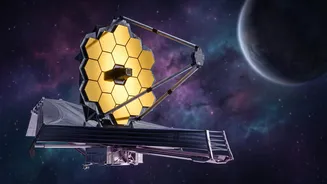
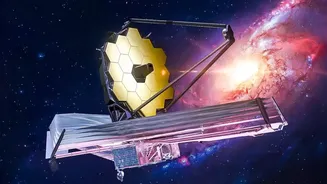
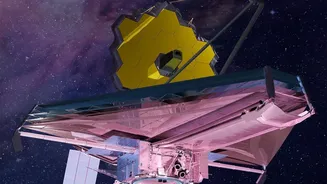
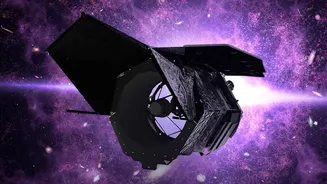
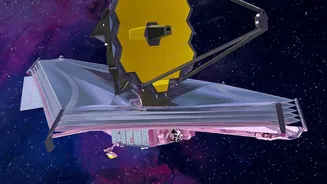
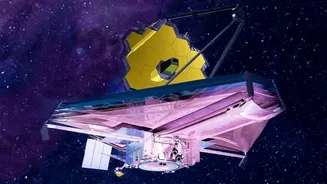
The James Webb Space Telescope was specifically designed to be the world's premier infrared observatory, and this capability is the key to its success in studying exoplanets. Firstly, planets emit most of their own faint heat as infrared light, while stars shine brightest in visible and ultraviolet light. By focusing on the infrared spectrum, JWST can more easily distinguish the planet's faint glow from its star's glare. Secondly, and most importantly, many of the molecules scientists want to find—like water, methane, and carbon dioxide—have unique chemical “fingerprints” in the infrared part of the spectrum. These molecules absorb very specific wavelengths of infrared light. When starlight passes through a planet's atmosphere, these molecules leave behind a distinct absorption pattern, like a barcode, that Webb's instruments can read.
The Science of Transit Spectroscopy
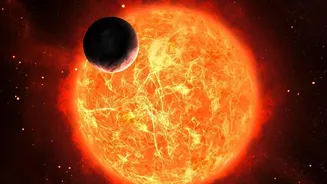
The primary method Webb uses is called transit spectroscopy. As an exoplanet passes, or transits, in front of its host star from our perspective, a tiny fraction of the starlight filters through the planet's atmosphere. Webb's highly sensitive instruments, particularly its Near-Infrared Spectrograph (NIRSpec) and Near-Infrared Imager and Slitless Spectrograph (NIRISS), capture this light and spread it out into a spectrum, like a rainbow. If water vapour is present in the atmosphere, it will absorb specific infrared colours from the starlight. By analysing which colours are missing from the spectrum, scientists can definitively confirm the presence of water and other key gases. This technique has been revolutionary, allowing Webb to detect water vapour in the atmospheres of numerous exoplanets, from hot gas giants to smaller, rocky worlds.
A Game-Changing Discovery
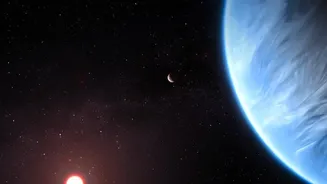
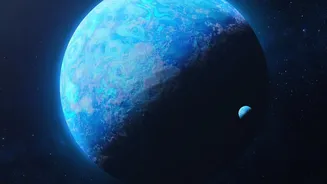
Webb's capabilities have already led to groundbreaking discoveries. A recent data release in September 2026 confirmed significant water vapour in the atmosphere of K2-18 b, a 'super-Earth' located about 120 light-years away. This planet is particularly exciting because it orbits within its star's habitable zone and is considered a prime candidate for being a 'Hycean' world—a hot planet with a liquid water ocean beneath a hydrogen-rich atmosphere. The detection, made using Webb's infrared spectrographs, showed the unmistakable absorption pattern of water molecules, stunning the research community. Just a few weeks prior, in late August 2026, Webb also detected water vapour in the inner disk of the young star system PDS 70, the very region where rocky, Earth-like planets are thought to be forming. This was the first time water was detected in the terrestrial region of a system already known to be forming planets, a feat impossible before Webb.