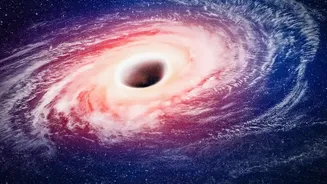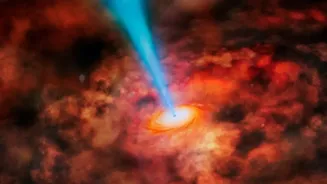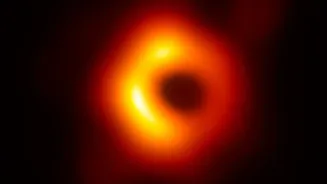




The universe is filled with mysteries, but few are as profound as dark matter and black holes. Now, some scientists believe these two cosmic puzzles might be linked, with giant black holes possibly forming from dark matter itself.
The Universe’s Greatest Unsolved Problems
Imagine everything we
can see in the cosmos—stars, planets, galaxies, all of it—makes up only 5% of the total universe. The rest is a puzzle. About 27% is 'dark matter', an invisible substance we can't detect directly, but whose gravitational pull we see acting on galaxies, preventing them from spinning apart. The other 68% is 'dark energy', but for now, let's focus on dark matter and another cosmic giant: black holes. Black holes are points in space with gravity so intense that not even light can escape. For decades, scientists have treated these two phenomena as separate, monumental challenges to our understanding. But what if they are two sides of the same coin? Recent observations and theories have started to build a controversial but compelling bridge between them.
Did Dark Matter Create Giant Black Holes?
One of the biggest head-scratchers in modern astronomy is the existence of supermassive black holes (SMBHs) in the very early universe. These giants, millions or even billions of times the mass of our Sun, are found at the centers of most large galaxies, including our own Milky Way. Standard theories suggest black holes grow over billions of years by consuming gas and stars or merging with other black holes. However, the James Webb Space Telescope has found SMBHs that existed when the universe was just a fraction of its current age, far too young to have grown so large through conventional means. This has led to a radical new idea: what if dark matter itself provided the 'seeds' for these ancient giants? Some models propose that in the early universe, dense halos of dark matter could have collapsed under their own gravity, forming massive black holes directly, skipping the 'star death' phase entirely.
A Different Breed: Primordial Black Holes
This is where the story gets another twist. The theory linking dark matter to giant black holes doesn't cover all black holes. There is another, more hypothetical type: primordial black holes (PBHs). Unlike their supermassive cousins or the smaller stellar-mass black holes formed from collapsing stars, PBHs are thought to have formed within the first second after the Big Bang. In that chaotic, early moment, tiny, ultra-dense pockets of matter could have collapsed directly into black holes of varying sizes, some potentially smaller than an atom and others much larger. For a long time, these PBHs have been considered a leading candidate for what dark matter is. The idea is that the universe could be filled with these ancient, tiny black holes, which would be invisible and interact only through gravity—exactly matching the description of dark matter.
Two Theories, One Mystery
So, we have two fascinating but distinct possibilities. In one scenario, dark matter isn't made of black holes, but it acts as a nursery for creating the supermassive ones we see at the center of galaxies. In this view, dark matter is a specific type of particle that can collapse to form black hole 'seeds'. In the other scenario, dark matter is a vast population of smaller, primordial black holes that formed right at the dawn of time. These two ideas aren't necessarily mutually exclusive, but they tackle different aspects of the cosmic puzzle. The first theory helps explain the impossibly large black holes in the early universe. The second offers a tangible identity for the elusive substance that shapes galaxies. Scientists are actively trying to test both hypotheses. For example, some studies argue that if dark matter were made of stupendously large black holes, it would leave a 'grainy' signature on the leftover radiation from the Big Bang, which we don't see.