




A Galaxy's Second Life
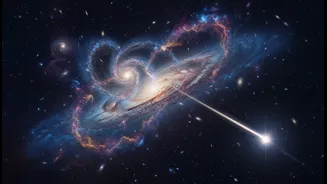
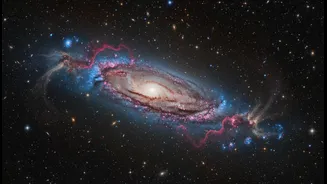
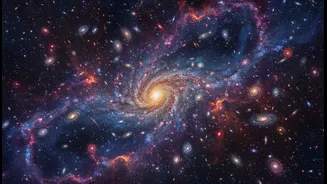
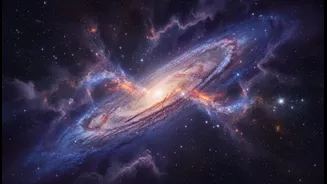
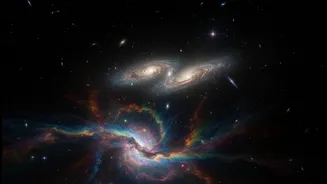
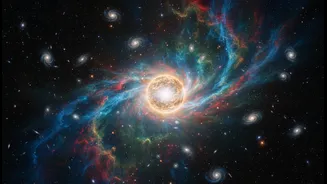
To celebrate the fourth anniversary of the James Webb Space Telescope's science operations, NASA and the ESA have released a stunningly detailed new view of Centaurus A. Located a relatively close 11 million light-years away, this galaxy is a hotbed of activity,
largely due to a colossal collision with another galaxy billions of years ago. While older telescopes like Hubble struggled to see past the thick lanes of dust obscuring the galaxy's core, Webb's powerful infrared instruments cut right through. The new images reveal a chaotic, glowing landscape where a supermassive black hole at the center actively feeds on gas and dust. More importantly, for the first time, astronomers can resolve millions of individual stars, allowing them to distinguish between different stellar generations. This provides an unprecedented opportunity to create a timeline of the galaxy's evolution and better understand how the central black hole both triggers bursts of star formation and sometimes stunts it by ejecting the very material needed to create new stars.
Cosmic Fireworks at a Stellar Nursery
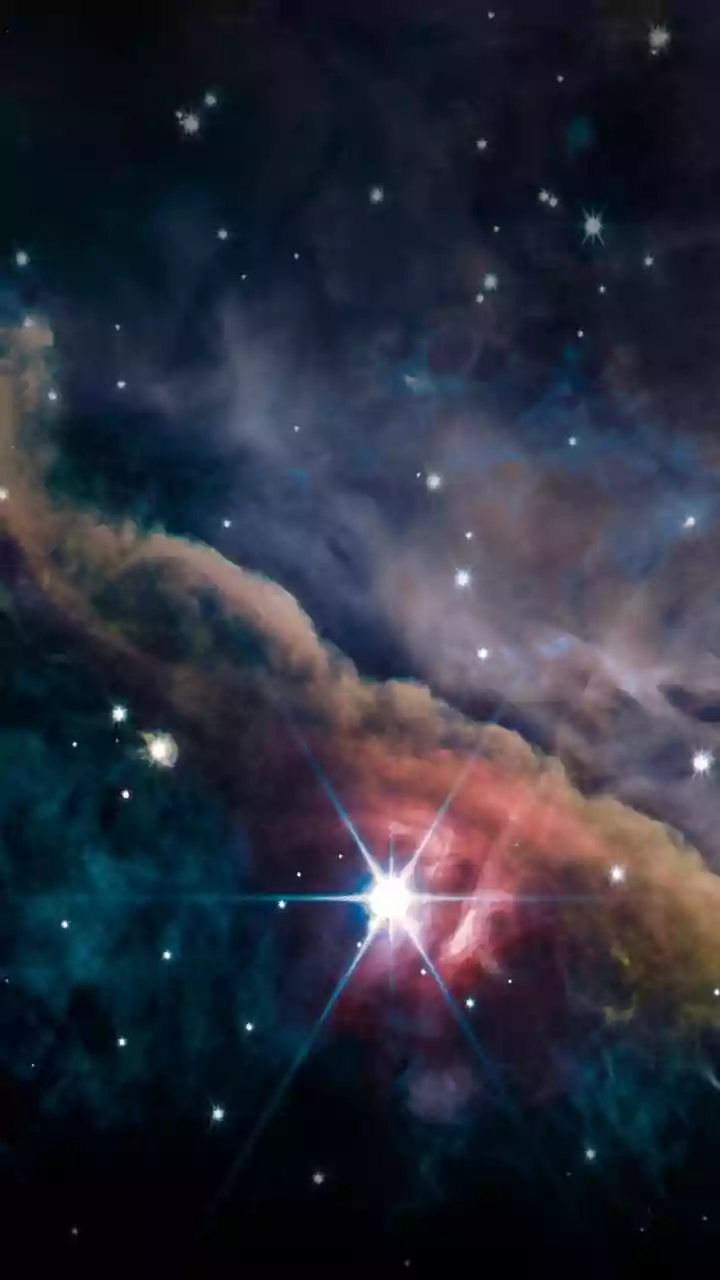
In another remarkable release, the James Webb Space Telescope (JWST) has captured an image of the FS Tau star system, showcasing infant stars, or 'protostars,' in a dramatic display. Located about 450 light-years away, this region is a popular target for studying the birth of low-mass stars. Previous observations by the Hubble telescope were largely blocked by the thick clouds of gas and dust. JWST’s infrared vision, however, pierces through this veil, revealing the protostars gathering material from their surroundings and occasionally blasting out jets of matter. These outflows create dramatic blue ridges in the image, which are dense regions of gas compressed and illuminated by the young stars. This new level of detail supports the theory that protostars accrete matter in distinct episodes, rather than a continuous flow, providing a clearer picture of the violent, energetic process of star birth.
A Planet That Survived Its Star's Death
Imagine a planet seven times larger than its star, orbiting it every 34 hours. This is the reality for exoplanet WD 1856 b, which orbits a white dwarf—the tiny, dense remnant of a sun-like star. When its star swelled into a red giant, it should have been destroyed. Using the JWST, an international team of astronomers has solved the mystery of its survival. By analyzing the planet's atmosphere as it passed in front of the star, they found signatures of methane and cloud particles—the first time an atmosphere has been detected on a planet orbiting a dead star. They also discovered the planet is much hotter than expected, suggesting it was reheated. The data indicates the planet migrated inward long after the star became a white dwarf, avoiding incineration and offering a fascinating glimpse into the possible future of planetary systems like our own.
Euclid's Census of the Ancient Universe
The ESA's Euclid space telescope is also making headlines with its own groundbreaking discoveries. The mission recently identified 31 new quasars—extremely bright galactic cores powered by supermassive black holes—from the dawn of the universe. Two of these are the most ancient quasars ever observed, shining when the cosmos was only 670 million years old, or about 5% of its current age. Before Euclid, finding these distant objects was a major challenge. Now, the telescope's wide-angle survey is creating a 'census' of these ancient giants for the first time, more than doubling the number known at such an early epoch. By studying these quasars, which form in the dense halos of dark matter, scientists can better probe the structure of the early universe and tackle the mystery of how galaxies and their central black holes grew so massive, so quickly.