








An Eight-Minute Cosmic Journey
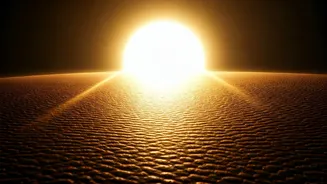
The feeling of sunshine is immediate, but the light itself is not. The Sun is, on average, about 150 million kilometres away from Earth. Light, the fastest thing in the universe, travels at a staggering 300,000 kilometres per second. A quick calculation
reveals that it takes sunlight approximately 8 minutes and 20 seconds to complete this epic journey. So, when you look at the sun (don't do that!), you're technically seeing it as it was over eight minutes ago. If the Sun were to suddenly vanish, we would remain in blissful, sunlit ignorance for more than eight minutes before the darkness and cold arrived. Every ray of light warming your face is a tiny time traveller from the recent past.
More Than Just Visible Light
The sunlight that completes this journey is more than just the warm, yellow glow we see. It’s a full spectrum of electromagnetic radiation. While our atmosphere does a brilliant job of filtering out the most harmful rays, like UVC, it allows visible light, infrared radiation (which we feel as heat), and ultraviolet (UV) radiation to pass through. The two types of UV rays that reach your skin are UVA and UVB. UVA rays have a longer wavelength and penetrate deep into the skin, contributing to premature ageing. UVB rays have a shorter wavelength, affect the outer layers of the skin, and are the primary cause of sunburn. These invisible travellers are the ones we need to be most mindful of.
The Moment of Impact
So, what happens in the instant those eight-minute-old rays hit your skin? Your body mounts a defence. In response to UV radiation, specialised cells called melanocytes begin to produce more melanin. This is the pigment that gives our skin, hair, and eyes their colour. The increased melanin is what we see as a tan. It's your body's natural, albeit imperfect, way of creating a shield to protect the deeper layers of skin from further DNA damage. A sunburn, on the other hand, is not a tan gone wrong; it's a sign of significant cellular damage. The redness and pain are the result of your body's inflammatory response to repair or clear away the sun-damaged cells.
Your Skin Has a Long Memory
The effects of sun exposure are cumulative. Your skin remembers every single minute of unprotected sun, from childhood games to your daily commute. This long-term exposure, especially to UVA rays, breaks down collagen and elastin fibres in the skin—a process known as photoaging. This leads to wrinkles, fine lines, leathery texture, and sunspots long before natural ageing would. More critically, the DNA damage caused by UVB rays can accumulate over time, leading to mutations that can eventually result in skin cancer. While darker Indian skin tones have more protective melanin, they are not immune to sun damage or skin cancer, making protection essential for everyone.
Living Smart Under the Indian Sun
Respecting the sun’s power doesn't mean hiding from it. It means being smart. In a country like India, where the sun's intensity is high for most of the year, this is especially crucial. The simplest rule is to seek shade during peak UV hours, typically between 10 a.m. and 4 p.m. When you are out, make broad-spectrum sunscreen with an SPF of 30 or higher a non-negotiable part of your daily routine—yes, even on cloudy days, as up to 80% of UV rays can penetrate clouds. Protective clothing, like long-sleeved shirts and wide-brimmed hats, provides a physical barrier. Sunglasses that block UV rays are vital for protecting your eyes. These simple habits allow you to enjoy the benefits of the sun while minimising its long-term risks.