



A Long-Awaited Voyage to an Ocean Moon
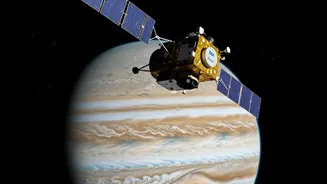
Launched in October 2024, the Europa Clipper is a sophisticated robotic explorer on a historic mission. As of August 2026, it is well into its 5.5-year voyage to the Jupiter system. Its destination is Europa, Jupiter's fourth-largest moon, which scientists
believe conceals a vast, saltwater ocean beneath its icy shell. This ocean may contain more than twice the amount of water found in all of Earth's oceans combined. The spacecraft itself is one of the largest NASA has ever built for a planetary mission, spanning the length of a basketball court with its solar arrays deployed. The mission's title, "Clipper," refers to its strategy: instead of orbiting the moon directly and getting fried by Jupiter's intense radiation, it will orbit Jupiter and perform dozens of close, fast flybys of Europa, much like the swift clipper ships of the 19th century.
Why Europa Is So Compelling
For decades, Europa has been a top candidate in the search for extraterrestrial life. Evidence gathered by previous missions like Galileo strongly suggests the presence of a global liquid water ocean. This is made possible not by heat from the sun, but by a process called tidal heating; Jupiter's immense gravity constantly squeezes and stretches the moon, generating enough internal friction to keep its ocean from freezing solid. Scientists believe Europa possesses the three key ingredients for life as we know it: liquid water, essential chemical elements (like carbon, hydrogen, and oxygen), and a source of energy. Its rocky seafloor may host hydrothermal vents similar to those on Earth, which could supply chemical nutrients to support a potential ecosystem in the dark depths.
A Toolkit for Habitability, Not a Life Detector
It’s important to clarify that Europa Clipper is not designed to find life directly. Its primary goal is to determine if Europa has the conditions suitable for life, a concept known as habitability. To do this, it carries a suite of nine advanced scientific instruments shielded inside a radiation-proof vault. These include an ice-penetrating radar to measure the thickness of the ice shell, a magnetometer to confirm the ocean's depth and saltiness, and high-resolution cameras to map the fractured surface. Spectrometers will analyze the chemical composition of the surface and any gases in the moon's thin atmosphere. While it won't spot aliens, it will provide the most detailed study of an ocean world ever attempted.
Searching for Plumes of Ocean Spray
One of the mission's most exciting prospects is the chance to fly through and sample plumes of water vapor that may be erupting from Europa's ocean into space. The Hubble Space Telescope has seen tantalizing, though unconfirmed, evidence of such geysers. If these plumes exist and originate from the ocean, they could offer a direct sample of its chemistry without having to drill through miles of ice. The Clipper is equipped with a mass spectrometer and a dust analyzer designed to scoop up these particles and analyze them for organic molecules—the chemical building blocks of life. However, recent analysis has cast some doubt on the frequency and even existence of these plumes, making Clipper's direct observations all the more critical to settling the debate.
The Ultimate Question
The Clipper is expected to arrive in the Jupiter system in April 2030 and begin its science phase, performing nearly 50 flybys over several years. Each pass will bring it as close as 25 kilometers to the surface, gathering unprecedented data. What it finds will fundamentally reshape our understanding of habitable worlds beyond Earth. If Europa Clipper confirms that the moon has all the right ingredients for life, it will pave the way for future missions, potentially including a lander that could one day drill into the ice and search for life directly. The mission expands our very definition of a "habitable zone," proving that life could potentially thrive in dark oceans far from a star's warmth.